Duolingo CEO: What I Tell Every Employee About Surviving AI — Silicon Valley Girl Podcast
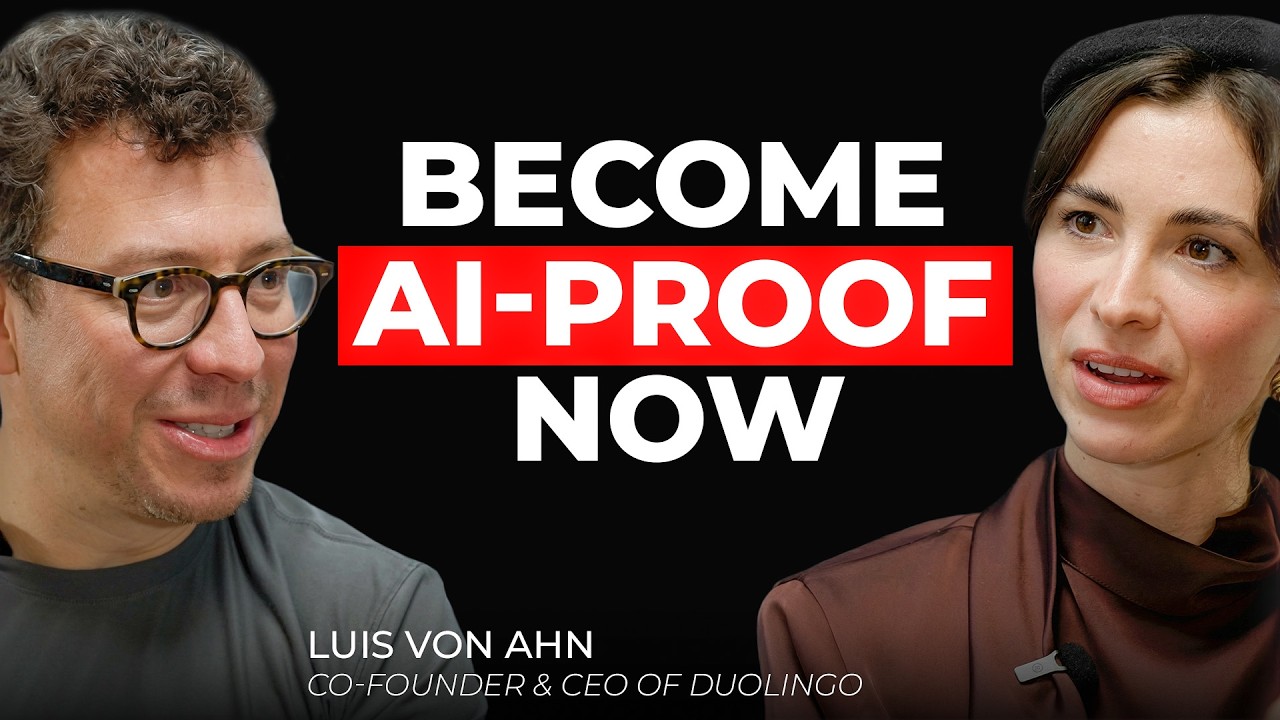
Marina Mogilko: Hey guys, welcome to Silicon Valley Girl. We are about to interview the founder of Duolingo. Oh. Oh, no. No, no, no. Do not you. No, no, no. Do we have the actual founder?
**:** Hi.
Marina Mogilko: Hi.
**:** Hi.
Marina Mogilko: Your employees are getting a little creative.
Luis Von Ahn: We pay that guy and he has his own personality. He just does what he wants.
Luis Von Ahn: AI is not going to take your job. Somebody using AI is going to take your job.
Marina Mogilko: This is Luis Von Ahn, CEO of Duolingo. Recently, two of his employees built a chess course with AI in six months. No engineering background, no knowledge of the subject. It became the fastest growing course in the company. There are a lot of rumors large companies firing people. They say it's AI.
Luis Von Ahn: We have never done a layoff. Despite what the internet may think, it is important to continue hiring people because a single employee is just way more productive now than they used to be. I'm going to name five professions and you're going to make some predictions. Gone in five years are not going anywhere.
Marina Mogilko: There will be fewer and fewer. Please, you told your team that nobody gets hired unless team proves AI can do the work first. Can you tell me how you actually track that? As a founder,
Luis Von Ahn: our goal here is to use AI to benefit our users. Internally, we have this golden rule. We're only going to use AI to benefit our learners. Some people may imagine that some companies may be firing people and having AI do their job. That's not what we're doing whatsoever. Our team has gotten significantly better at using AI over the last couple of years. And that has allowed us to do a lot more. It has allowed us to put out a lot more content, a lot more learning content, etc. We as a management team are not necessarily tracking whether you are doing something that AI can do or not. We're just really trying to tell everyone to try to be as efficient as possible with AI and our employees are doing that.
Marina Mogilko: And can you give me some of the best examples from the team for someone who's watching this and they're like okay my manager tells me to start using AI but I have no idea how to do it. Do you have best case examples?
Luis Von Ahn: It depends on what your job role is. I think most of our engineers have basically really changed their workflows. They're using AI coding tools. A lot of our product managers, what they've decided to do is using AI to make prototypes of things. So the product manager may not be implementing the thing in the full production app, but rather than coming to us with a written document, they come with a prototype. Now that's way better because it allows for much better decision-making. So, if somebody comes to me with a written proposal and says I'm going to do a way to teach Spanish better, it's hard for me to know what that actually means. But if they just show me the prototype and I can see that it really does seem to teach Spanish better, it's much easier to give approval to that type of thing. So, it depends a lot on the role.
Marina Mogilko: Do you give them any guidance like okay, instead of doing this, do that next time or how do they even find out they can do these things with AI?
Luis Von Ahn: We try to do some things in the whole company to try to, we had for example a few months ago we had a day where everybody in the company had to code something—not just engineers, every single person, people from HR, people from the finance team, everybody had to code something so everybody could see the power of it. We also have a lot of documentation about best practices but generally people here in Duolingo are pretty smart. They're always finding new things and I think what happens is rather than management telling them what to do, they tell each other what to do. There's a lot of Slack channels, one of them is called best AI practices and so people are just saying stuff. We also have another one that's called AI fails, which is all the times, all the things that people tried. It's an incredible thing, very empowering for people who are like oh my god I made, usually they're very small apps but it's like I made an app. One of the things that has happened inside this company is everybody has made their own dashboard for their KPIs or something. I mean, I see a few product managers that have coded a whole thing with data about our users in every country and what they're doing.
Marina Mogilko: That's super impressive. And is that how you track AI proficiency? Because now it's part of performance reviews, right? At Duolingo,
Luis Von Ahn: for a while it was part of performance reviews. We decided not to do that. And I'll tell you why. I sent a memo to the company that said you know part of your performance review is going to be usage of AI and we found that people were, I don't know if they were doing that but they were kind of asking, do you just want us to use AI for AI's sake? And at the end we backtracked and we said no, look, the most important thing in your performance is that you are doing whatever your job is as well as possible. A lot of times AI can help you with that but if it can't, I'm not going to force you to do that. So I think we backtracked from that because it really felt like rather than being held accountable for the actual outcome, we're trying to just push something that in some cases did not fit.
Marina Mogilko: Do you have a specific example where somebody did something in a week without AI and then with AI they kind of multiplied the output? We now teach chess on Duolingo. So for a long time we only taught languages, now we teach a few other things. Chess is the latest course we added. This course got started by two people, neither of whom knew chess, neither of whom knew how to program. They basically coded the first prototype of it. Now the final version that is actually in the app, of course we put some engineers in there, etc. But they really got very far in a span of about 6 months. They created the whole curriculum for chess. They created a prototype of the app entirely with AI. And again, these people did not know any chess.
Luis Von Ahn: And whose idea was that? Was it their idea to do that?
Marina Mogilko: It was their idea to do that. They also, it was well, they're the ones who wanted to add chess. By the way, they came to me a year earlier to say, "We want to add chess." I said, "I don't want to add chess," because it's just a game and we're an education app. But what happened was that a few months later, I talked to the minister of education of my country. I'm from Guatemala. And she said to me, "Our education system, our public education system in Guatemala is so broken that I'm considering sending every student a chessboard so that at least they'll learn logical thinking." And when she said that to me, I thought, "Oh, wow. Okay, this is actually part of education." So then, I told them, "Okay, you can add the chess course," but I said to them, but I don't have any engineers to give you, so go ahead. And they figured it out.
Luis Von Ahn: 6 months, right?
Marina Mogilko: About 6 months. Yeah. And now it's your fastest growing course.
Luis Von Ahn: Yeah. At this point we have seven million daily active users that are learning chess. Wow, this is fascinating. Can you tell me step by step what was their process? So if somebody's watching and they're like wow if Duolingo is able to do such a spin-off which is kind of different from languages, if I want to start something with AI and build a fast growing product, what are the five steps they need to take?
Marina Mogilko: These two guys, the first thing they did was probably learn chess, probably because they didn't know any chess and that's one of the reasons they wanted to add it because they themselves wanted to learn chess. But after that, what they did is they really started looking at the different tools that are out there for learning chess. They were basically doing market research trying to figure out what's out there for learning chess. They found that really what was out there was not all that great. And then they decided to start coding something. To be fair, this person does have some technical knowledge. They're not an engineer, but they have some technical knowledge. And so they downloaded cursor and at first they made just chess puzzles. Then they realized that the AI was not very good at making chess puzzles. So then they decided to train it with some, there's an online database of a lot of different chess puzzles. So they trained the AI with that and it got a lot better. And then after that what they started doing was just more and more mobile prototypes for me to play with until I told them that it was good enough to really put it in the app.
Luis Von Ahn: And then you put it in the app and then did you give it an external push or people just started discovering it?
Marina Mogilko: By putting it in the app very quickly a lot of people came but chess really has a big draw. I mean we put other courses in the app that have not grown as much. For example, it turns out chess is more fun than math. So for someone a student who just heard about your chess course that was spun out so quickly and they want to start building something with AI today, what advice would you give them?
Luis Von Ahn: The biggest advice I can give them is to start. A lot of people talk a lot about starting. They're like, "Oh, I have an idea," but the biggest thing is just sit down and do it. You will learn a lot by just trying to do it. Other than that, try to learn how some of the best tools work. Certainly, VIP coding will help you a lot, but it's not just VIP coding. Trying to make the initial designs for it. Now, you can have AI tools to make the initial screens and everything. So use it all and try to make the thing. I haven't quite yet seen somebody who knows nothing about programming to really make a good app, but I have seen people who know a little bit about programming make apps. So I would tell you it's still worthwhile learning the structure of programs. That seems important. Even though you may not actually need to program word by word, just knowing how things work. For example, knowing the difference between the server and the client—just these very basic things. I think that's important.
Marina Mogilko: Did it give you more ideas to add more courses that are non-language related?
Luis Von Ahn: It's given us a lot of ideas. We are not yet working on other stuff, but we have a long list of things that we want to teach—all kinds of things, K through 12 science. We want to teach K through 12 science. We want to teach how to draw. There's all kinds of things, but at the moment, we're not really working on them because we want to continue working on chess, math, music, and languages.
Marina Mogilko: Got it. But then any employee can just go and VIP code one of these courses and show you and maybe—
Luis Von Ahn: Yeah, that's what I tell the company, by the way. A lot of times people come to me and they're like, "What course are you going to add next?" And what one of the things I tell them is I wanted to add K through 12 science and then we added math. I wanted to add K through 12 science and then we added music. I wanted to add K through 12 science and then we added chess. At this point I also want to add K through 12 science. But it turns out that what people do here is somebody comes up with a really good idea and if it's good and they're passionate about it, we let them do it.
Marina Mogilko: Let's go back to the AI failure chat. Can you recall any examples of AI actually failing in a task?
Luis Von Ahn: Oh, there's a lot of things where it's failing. I'll tell you the biggest one, which I think we're starting to see a difference here, but it wasn't the case a year ago. If you were to look at Twitter and just read what people are saying on Twitter. Two years ago I should have fired all our engineers because on Twitter they're like, "AI is better at coding than engineers." This is what they've been saying on Twitter for the last two years, and it was an interesting thing because I would come here and I would not really see a speed up on engineering. I'm like, well, what's the disconnect? Why are all these people saying that AI is better at coding than humans, and the reality is it's not yet the case that AI is better at coding than humans? I think you still really need engineers and you're going to need them for a long time. But we've seen a lot of cases where you tell the AI to program something and sometimes it works, but I don't know what fraction of time it doesn't work. When it doesn't work, there's a real problem in that because you don't really know what it did—it's really hard to debug it. That's what has happened. The happy path is really fast. Okay, it worked. But the unhappy path makes it so that it takes so long that you end up spending more effort on that than the time you saved on the other things. We've seen that quite a bit. We've also seen AI not be able to generate things like narrative or stories. Sometimes it does a good job, sometimes it doesn't do a great job and it just comes up with things that don't make any sense. It's interesting because when you see a demo and you ask it to come up with a story, somehow those demos always look amazing. But then when you try to come up with a hundred stories, you realize that only like 30 are good and the other 70 aren't.
Marina Mogilko: So human still needs to check and select.
Luis Von Ahn: Check, yeah. All our content needs to be there. There's a lot of steps to try to either check it or spot check it or something to make sure that the quality is high.
Marina Mogilko: So if we compare today and a year ago, how much more productive is the company with AI?
Luis Von Ahn: I don't know. It's more in pockets. And I don't know if any larger company that has seen like a 10x speed up.
Marina Mogilko: I don't think so. I think startups really see it because when you're a one person team you can work—
Luis Von Ahn: One person can do a lot of stuff. With a larger company it's harder. It just turns out, for example, most engineers don't spend eight hours a day coding. They have to go to meetings. They have to—so there's a part of it that you just cannot speed up. Then there's the part that they spend coding. Okay, maybe you can speed that up, but you cannot speed it up. At least at the moment you cannot speed it up by a thousandx. We're seeing some speed ups here and there in different pockets of the company. But it's what you said. One person companies are a lot faster, but it's because you don't have to interface with all the other parts of the company. Also, AI is not as good with existing code bases rather than with a brand new codebase.
We've been talking a lot about how AI is changing the way people learn and retain information. And that got me thinking about something I changed in how I organize my own daily life and work. Someone told me once, if you're not capturing everything that happens in your calls with your team, you're actually losing to other companies. You're losing decisions that were made. You're losing context that gets dropped, things you're committed to and then you just forgot. Team syncs, strategy sessions, calls with investors, even a quick conversation with a contractor—it all disappears the moment the call ends. I'm on calls every single day. Sometimes I forget to press record. Sometimes I don't think the conversation is worth recording, but then after the conversation, I realize I had to actually record that. One of my friends told me, "Marina, you should start using Granola. You'll be blown away." And now I use it on every single call. It's an AI notepad for meetings, but it's not a bot that joins your Zoom and makes everyone uncomfortable. It transcribes your computer's audio in the background while you stay completely present in the conversation. It listens to every call automatically, and if it's a recurring call, it merges them by folders. So by the time the meeting ends, you have clean, structured notes ready to go. After the call, I chat with my notes. I'm like, "Okay, we just had this conversation. Can you create a follow-up email that I'm going to send to Monica, my manager? We're going to proceed with this, this, and that." It creates the email and I just send it. Takes 15 seconds. It works across Zoom, Google Meet, and Teams. It's one of those tools I genuinely can't work without anymore. And I don't think you'll be able to either once you try it. Try it on your very first meeting after this episode. Head to granola.ai/marina to get three months of Granola for free or enter the code marina at checkout. I left a link in the description. Now back to my conversation with Luis.
Marina Mogilko: What about you as a founder? Does AI help you make decisions or any workflows that work for you?
Luis Von Ahn: Research? Sure. It used to be the case that whenever I had something that needed to be researched—like, I don't know, what is the chess landscape in India, for example. I used to need to either spend a lot of time myself or get a team of people to help me. Whereas now I can get a pretty good idea by just asking Gemini or something like that. So research I do a lot more by myself. That has helped me, but ultimately the decisions are made by me. It's not like I asked the computer what would you decide.
Marina Mogilko: So you don't use it as a coach or you haven't VIP coded your own KPIs or whatever.
Luis Von Ahn: I've done a bunch of VIP coding for things, certainly my KPIs, but the decisions I still make myself.
Marina Mogilko: Okay. I interview a lot of cool people on this podcast. In the past three weeks, I had Reed Hoppin and Bill Gurley, who are legendary investors, and I asked them a question: What is the first market that's going to be completely changed by AI and a market you should be looking at? And they told me language.
Luis Von Ahn: Thank you so much. You know, it's been my thing for 10 years. What do you think?
Marina Mogilko: I don't know what that means, "change." Like you don't have to learn a language because everything is translated?
Luis Von Ahn: Oh no, I just don't buy that. If you look at our users, we have more than 100 million active users. Half of them are learning as a hobby. It's a hobby. Whether AI can do it or not, it's a hobby. Actually, chess is a great example. Computers have been better at chess than humans since 1997.
Marina Mogilko: A lot more people are learning chess today than they were in 1997. It's a hobby. So for half of our learners, it's a hobby. And I don't think whether computers can do it or not, I don't think it'll matter. The other half are learning English. And I think anybody who tells you that people don't want to learn a language has not had to learn English.
**:** It's interesting how you say 50% are probably learning other languages as a hobby. Yes. English necessity.
Marina Mogilko: Yes. But that's how it is in the world. If you're learning French, it's a hobby. It's not always true. I'm sure there are people who actually need to move to France, but it's a small fraction. The majority of people in the world that are learning French want to feel cool when they go to Paris so they can order a croissant. And that's our use case. Someone who's lived their entire life in the US, who's never had to learn English because that's their native language, will say something like, well, languages are unnecessary. But somebody who's had to learn English, it's a different thing. You just need to learn English. You may want to move to an English speaking country. You may need to go to a university. Nobody's going to be allowing you to go to a university with a phone that translates everything the professor says. That's just not going to happen. So I'm just not particularly worried about that.
Marina Mogilko: Is there a fraction of the market? So I'm thinking about translators for example. Somebody spends four years learning that. What would you say to those people?
**:** It depends on what it is. But there are fractions of the market that are probably going to change quite a bit. In terms of the demand, I agree that some people may have wanted to learn a little bit of a language if they were going to just visit Germany for two days, and maybe now they're just not going to do that because they can just use translation. But at least when you look at Duolingo's users, that's a very small minority of our users. The majority really are hobby or English. So I'm just not worried. The other thing about language translation is that simultaneous language translation has been really good for this. It's not an LLM thing—LLMs are good at it too—but Google Translate did not use LLMs and it was really good ten years ago. We've seen the demand to learn a language actually go up as opposed to go down. This is not something that we internally are worried about.
Marina Mogilko: Yeah. I'm also thinking if you have glasses for example that are smart and they translate everything for you automatically. I haven't seen that case with the headphones. I don't think people really use the AirPods to translate.
**:** No. Then I'm thinking maybe it's glasses that translate the signs. I don't know. When we came to Silicon Valley, I think in 2015, we were pitching our company Lingua Trip, which does language travel and language courses.
Marina Mogilko: And I think American investors were like, "Oh, this is not a market. Oh, this is going to go down."
**:** We've had this problem at Duolingo from the entirety of the company. We are a company based in the United States. When we first pitched Duolingo to investors here, I don't know how many years ago, the most common thing is like nobody really wants to learn a language. Math though—people want to learn math. I'm sure investors think that because they are good at math and they wanted to learn math. But the reality is there are more people learning languages in the world than there are people learning math.
Marina Mogilko: What was your mindset when the smartest people in the world tell you that you're wrong? I just—
**:** I grew up in Guatemala. I could see what it was to have to learn English. It is a huge thing to learn English. It changes people's lives.
Marina Mogilko: I know that's my case as well. Absolutely.
**:** Do you have another worry? So you have an app, right? But now we're in the era when anyone can code an app for themselves. What if I go to Claude and ask, can you gamify my experience, create me an app that's personalized to me, my interests, my hobbies. Do you worry about that?
Marina Mogilko: A little bit, but not really. Inside the company we never talk about this. We see Twitter talking about it or investors talking about it, but we internally don't talk about it. Ultimately, I think you can ask AI to make you an app, but making a really good app is not that easy. We have data from hundreds of millions of people about how they learn a language every single day. More than a billion exercises are answered on Duolingo, and we use that data to teach you better. We have a lot of data on how to keep you motivated. There are probably two or three thousand language learning apps in the world. They've been there, and now with code generation, there will probably be twenty thousand rather than two or three thousand. But at the moment we're just not particularly concerned. Something may happen.
**:** Is there anything that concerned you? Because I'm asking this question because I talked to people and they're like, this is going to be eliminated, this is going to—we're done. And you're like, it's fine.
Marina Mogilko: No, I wouldn't say that it's all fine. I do think a lot of things are going to change.
**:** What do you think is going to change? What are you preparing for?
Marina Mogilko: I think that user expectations are going to change and I think we have to stay ahead of it. A good example is one of the things we have in the app is conversation practice with AI. When we first put that out there, the cost of it was high for us. So we put it behind the most expensive tier. You have to pay a lot for the subscription to get the conversation practice. At the moment the cost of that has come down enough that we're going to start giving it to much cheaper tiers, and we are probably going to eventually give it away for free. We're doing that because I believe that customers are going to start expecting that. I think there will be apps that start doing this for free, and if we don't do it now, we'll be forced to do it in a few years. That's the type of stuff we're doing to prepare for this because I think we just need to stay ahead.
**:** So users will expect more from—
Marina Mogilko: I think users will expect more. I think users will expect the apps to be a lot more intelligent, which they should. We're undergoing a platform shift here, and what ends up happening in platform shifts is that the companies who were the winner before the platform shift may or may not remain the winner after that. So I hope that we can do that. Also, talking about AI and workforce, I just talked to Gary Vaynerchuk and I really like what he said. There are a lot of rumors of large companies firing people and they say it's AI. Gary said something that struck me because he said if I fire one hundred people, my competitor hires them and they still 10x their output. I'm dumb for firing them. How do you think about that?
**:** We have never laid anybody off here. We have never done a layoff despite what the internet may think.
Marina Mogilko: You've never done a layoff.
**:** We've never done a layoff here. I think that it is important to continue hiring people because now the way I see it, a single employee is just way more productive now than they used to be. So I get better return on investment by having another employee. That's how I see it. My sense—of course I cannot speak about very specific companies—but my sense is that at least in some of the cases, AI is just an easy PR reasoning.
Marina Mogilko: Yeah. Usually what happened is you overhired, and when you overhired, you're like, okay, because of AI we're going to do that. I don't—at least at Duolingo, the way we run the company, I am surprised that there are companies doing that because I see no reason.
**:** Yeah. I was just at Davos and I was talking to somebody who releases their jobs report. All the layoffs are structural—overhired during COVID. So it's not really—
Marina Mogilko: A lot of companies overhire during COVID, and I understand that. If you overhired, you probably don't need these people. But blaming AI is an easy scapegoat.
**:** It is what he just said actually worries me the most. Everyone's talking about AI replacing jobs and big companies firing people. This is not what's happening here. He's actually hiring people, but he's hiring those who know AI. Same for me where we're just hiring a social media manager. And the questions I was asking them during the interview, how you going to automate this? How are you going to use AI in this process? Founders are looking for people who utilize AI in their work. And this is actually what my newsletter is about. It's called future proof. And every week I share what we learned with AI. My PR person just vipoded the whole website with all the transcripts from this podcast. And we share things like that in the newsletter. So first of all, subscribe to this channel and second subscribe to the newsletter. Can we talk about the stock price because I when I was preparing for this, I saw the 82% collapse of the stock. But what I really want to talk about because you explained that to your shareholders.
Marina Mogilko: Can you walk me through your mindset as a founder when you make such decisions who make your users happy but they don't make your investors happy?
**:** Well, the decision was made by AI. Oh, I'm kidding. That is a joke. That is not what happened. I made that decision. My look, we made a conscious shift in how we run the company. I made a conscious shift and certainly the executive team was behind me. But we got to a point where, if you look at over the last 5 years, we've grown a lot. We became a public company in 2021. We have grown our user base by more like our active users by more than 5x since then. So we've grown a lot. We've also grown our revenue by a similar amount. We've grown a lot but two things happened. One is that throughout 2025 we've been still growing but we were growing slower than we're growing in previous years. So that's one thing that happened—our user base was growing slower than in previous years. The second thing that happened is because of AI I really do believe that education is going to change quite a bit. And we are a really important player in the education category and I want to be in a situation where we can lead some of that change through AI. So the combination of I want to lead through that change in AI and our user growth slowing down told me we need to do something important change how we operate so that we continue grabbing as many users as possible. Now that comes with a cost which is we are not going to be monetizing our user base as much as we were before and investors don't love that.
Marina Mogilko: But we knew when we made this decision we talked to of course all internally our finance team everybody agreed this is going to decrease our stock price. Did you expect that number like 80 82?
**:** I didn't know exactly what to expect honestly but I knew that it was going to be a lot. So we knew that but we made the decision consciously because we think that if we continued operating the way we were operating, we probably could have continued growing a little bit, but at some point it was going to be capped. Whereas, I think if we really try to get a much larger user base, we're going to be a much larger company in the long term. And the thing is, I'm operating this company. I'm hoping that this is my last job and this is the last thing that I do. And I have many more years of energy left.
Marina Mogilko: And you never regretted the decision.
**:** Oh, no. No. That is amazing because as a founder again hearing from the market what they think about your decision is tough. I don't regret the decision because I believe that it is the right decision, but it's not that it hasn't been tough.
Marina Mogilko: It's tough. I really still am very convinced this is the right decision.
**:** Do you feel like because you're founder of a publicly traded company, does your mood depend on your stock price?
Marina Mogilko: It used to when we first went public. It used to I learned to stop looking at least every day. I mean, it's not that I don't know the ballpark, but I don't look every day. It used to be the case the first year or so. It'd be like it went up by a dollar, it went down by a dollar. Now it's not good.
**:** You're used to it because as a creator my self-worth depends on how my last video is performing which is not right which is not good for my mental health. I'm learning how to not look at it.
Marina Mogilko: Well I will tell you this. The same is true for me but not with our stock price. It's with daily active users. Every morning, yes, it's growing and everything, but every morning I, our daily active user report for the previous day comes at 5:00 a.m. Exactly. I wake up very early. Every morning at 5:01 a.m., my mood gets set.
**:** It's not good.
Marina Mogilko: Do you think you should adjust it for a second?
**:** It's not good mentally, but I prefer this than the stock price, though. This makes more sense. At least this is something you can control.
Marina Mogilko: This is something I can control, and it's an actual measure of the health of this company. The stock price some of it is over the long term it is a good measure of the health of this company but on a day-to-day basis we used to there used to be days that the stock price went down because oil prices changed and I'm like, how is that related to me.
**:** Do you have any other mental hacks because I'm talking to you again you're not really worried about AI you learned how to make stock price not control your mood. Do you have any mental life hacks that you developed as a founder during these? What helps you? What do you think? What do you do when something goes bad? Do you go on walks to create ideas?
Marina Mogilko: I mean, don't get me wrong, when something goes bad, I get to me. It definitely gets to me. I try to really think about the long term. One of the things that has helped me the most is really thinking about this. This is not just about the company. This is in general. And of course, I didn't invent this. A lot of people say this. Thinking about anything. Will this matter in six months? The vast majority of things will not matter in six months. The vast majority of things. So sometimes I get really upset and I think about it. Will this matter in six months? Some things will, but the vast majority of things will not matter in six months. And that makes me feel a lot better because I think, okay, I'm upset for no reason because this is going to fizzle out.
**:** What about other things like marketing or content? Do you think it matters for a founder?
Marina Mogilko: Depending on what type of company you're doing. Certainly if you're doing a consumer company, marketing is going to end up mattering. It's going to end up mattering a lot. I mean, I love our marketing team. They are excellent. They've done some really creative things over the years and have helped us grow a lot. I don't know of any hacks. I mean, ultimately, you need to figure out how to get the word out for your product. I will say I have seen many people try to cover a bad product with good marketing and that can only get you so far. The reality is if you want to really succeed, your product has to be good. I think good product, bad marketing is not very good, but bad product, good marketing is worse.
**:** Do you have time set for yourself every week when you play with the new AI tools or you just discover on the go?
Marina Mogilko: No, I don't know if I have time that I've set for myself like that, but basically what happens is I talk to some of the employees. I know who in the company is at the forefront and I talk to them and then they tell me, "Oh, you should try that. You should try that." And then I go, I try it.
**:** And for someone who's employed at a company and they want to hear advice from a founder whose company's using AI, what would you say to them? How do they start implementing AI in their job?
Marina Mogilko: Again, it depends a lot on their job. There are a lot of different tools for a lot of different things. It's not that hard to find the right tool for your job and then try to use it and see if you can automate parts of your job with it. A lot of our employees have automated parts of their job. Not the whole thing, but parts of their job.
**:** I like that they're doing this by themselves. That actually says a lot about the way you hire. And when you're doing interviews now, are you asking about this?
Marina Mogilko: We do ask. We want people here to be open to it. I mean, we really do see the people who are a lot more open to using AI versus the people who are like, nah. We want people who are more open. I mean, there's a good thing that somebody said that I pretty much believe. AI is not going to take your job. Somebody using AI is going to take your job. And I believe that is mostly true. It's 10x more productive.
**:** This is way more productive tools. Do you believe that in 10 years we'll have millions of AI agents in our companies?
Marina Mogilko: Probably. It's what I've learned in the last few years especially is that predicting the future has gotten much harder because of AI. If you talked to me 10 years ago, I could have told you what the next year was going to look like or what the next three years were going to look like. We're probably going to have a new version of the iPhone. It's going to have a better screen. It was just not that hard to predict. It was boring.
**:** Whereas now,
Marina Mogilko: I'm very bad at predicting what's going to happen.
**:** But you're not nervous.
Marina Mogilko: I am nervous—not for the immediate term and not necessarily for this company, but I am nervous about a shift that I do believe is going to happen. I'm nervous because I just don't know what that's going to be. There's different founders telling you things that are pretty self-serving. If you work in a company that makes AI for lawyers, they'll tell you lawyers are going to disappear. Everybody's saying these self-serving things. I don't know what they are, but I do think something's going to change and I'm nervous because I don't know what that is.
**:** Nobody knows. Go with the flow.
Marina Mogilko: Nobody does. And I think the best thing you can do is try to adapt as fast as possible. By the way, I am glad that I'm not having to choose a college career right now because I have no idea what I would choose.
**:** Yeah, it's even tougher now.
Marina Mogilko: Yeah, I have no idea what I would choose.
**:** I have a blitz for you. So I'm going to name five professions and you're going to make some predictions. What do you think?
Marina Mogilko: Oh, man. Predict. I'm very bad at that.
**:** Well, what your gut tells you. Gone in five years, gone in 10 years, or not going anywhere.
Marina Mogilko: Let's try social media manager.
**:** You mean for a company?
Marina Mogilko: Yeah, coming up with scripts.
**:** I don't think that's going anywhere.
Marina Mogilko: That's what I think.
**:** Translator.
Marina Mogilko: I think there will be cases where we're going to want real human translation, but there will be fewer and fewer. But I do think that for certain situations, we're going to want that. It's going to turn into very premium.
**:** Yeah. But for most everyday uses, it's going to go away.
Marina Mogilko: Okay. Teacher.
**:** Oh, not going away. I mean, look, teachers serve a lot of things and I cannot imagine they're going to go away. So I have a lot of thoughts about this. I'm a former teacher. I used to be a professor. I think AI is going to be great at teaching certain parts—certainly giving you a lot of repetition, maybe even adapting to what you learn—but ultimately teachers are great at putting things into context. They're also really great at making people want to do something. They're very inspiring. When I was growing up, I wanted to be my teachers. And it's hard to want to be an AI. I don't really want to be an AI, but a teacher—they're very inspiring. They put things into context. At the moment, I'm pretty certain that if you have a really great teacher, that is better than not having a teacher. Not all teachers are equally good, but computers are not as good at teaching as a really great teacher. That has not yet happened. I think it may start getting to the point where in certain aspects they're about as good, but I think having a teacher will always be better than not.
Marina Mogilko: I agree.
**:** That's what I think. So I don't believe that it's going anywhere. We're going to learn with AI, do some stuff, but we still need a human to reply to.
Marina Mogilko: This is what I think. It's also incredibly hard to keep people motivated, and teachers have ways to get people motivated to do certain things. They start noticing things like, "Oh, that student feels left out. I'm going to do something about it."
**:** This is pretty hard to do with AI. So I just can't imagine this is going to go away. Strategist—I don't know if you tried AI for strategy, but for me it's so good. Sometimes it notices things I wouldn't even think about. Like you were not working on Jio for your podcast.
Marina Mogilko: I'm like, "Oh shoot, yes, I'm not."
**:** And I'm not appearing in any searches. I recently asked Slack's Slackbot, and it sees all my conversations, and I asked it to give me what are my areas for improvement.
Marina Mogilko: And it was excellent.
**:** That's a very good prompt. It told me exactly what my 360 told me but in a much more concise way. Strategy—I don't know the answer to that question. I would say there's probably still some human ingenuity necessary for certain types of strategy. So again, it may be that it just becomes a very premium thing.
Marina Mogilko: Okay. Project manager.
**:** Oh no, I don't think that's going to go away. In my experience, really good project managers have really good EQ and end up figuring out why a project is not working. A lot of times the project is not working because that person doesn't get along with that person. I think that's going to be hard. There are parts of the process that can be automated, but in general, I can't imagine that AI is going to be really good at sitting two people there and being like, you two are not getting along. You need to start getting along. That seems hard.
Marina Mogilko: So, as someone who's running a company, do you think there are any positions that are going away in the nearest future, or they just going to be transformed?
**:** I think most of it is going to be transformed. And I think what will happen is that some companies, particularly companies that are not growing a lot, are going to find that they can do the same with fewer people.
Marina Mogilko: So it may not be very specific professions, but it will be like do we need 100 people doing customer service or can we do so with only 10?
**:** I think that will happen. The entire profession going away is hard. Even customer service—a lot of people say customer service is going to go away, but you probably still need a couple of humans to orchestrate it. So I do think that you'll find some companies that will need fewer people over time.
Marina Mogilko: Yeah, I totally feel that. We wanted to hire someone who would do my scripting for Instagram, but then I'm like, okay, I'll just try Claude. I created a Claude project and it was so good. I'm like, okay, I don't need to hire anyone. My social media manager can just do that now. So it's basically doing more with fewer people. Would you want to start again in 2026 if you could, if you could go back to how old you were when you started?
**:** I probably would start again, but if you ask me to choose between whether I want to start today or 15 years ago, I'm very happy we started 15 years ago. Because now with Duolingo, we have a lot of money because we're profitable. We have more than a billion dollars in the bank. We have a large user base. We have a large install base. So I feel pretty good about the situation that we're in. Whereas if we were to start today, I don't know. It's pretty hard to start today. I mean I would do it, but I—
Marina Mogilko: What would you start?
**:** Same thing.
Marina Mogilko: If Duolingo didn't exist, yeah, I mean given that Duolingo exists, I don't know if I would start that. I would start with languages. Interestingly, I am personally not a major language learning nerd. Neither is my co-founder Sein. What is interesting is that in retrospect I'm very happy we started with languages. I don't know of another subject even though we've done a lot of research. I don't know of another subject that gets learned as much. If you look, there's about two billion people in the world learning languages. That's the number.
**:** There's any other subject is less. I mean math is a billion.
Marina Mogilko: Math is one billion people. The number of people learning math in the world is highly correlated, almost identical, with the number of people in the world that are in K-through-12 education. This is about a billion. Nobody is learning math for pleasure as a hobby.
Marina Mogilko: I'm sure there are but this is a tiny fraction of the population. So math has about a billion. Anything like chess is 100 million something like that. Any subject K through 12 science is a few hundred million. Programming is 20 million.
**:** And when it comes to spending money—
Marina Mogilko: So language is 60 billion. It depends on who's spending the money.
**:** So governments and that's hard. That money is hard to get to because governments are—
Marina Mogilko: But so there's probably more spend on math, but it's because it's the governments.
**:** And what about consumers? So consumers the language.
Marina Mogilko: I think so. By the way, of those two billion people that are learning language, about 1.8 billion are learning English.
**:** So English is just really big.
Marina Mogilko: It's crazy. I didn't realize that because I thought it would be math or now AI, maybe software engineering.
**:** You and I live in a bubble.
Marina Mogilko: We do. We live in a bubble.
**:** Because we got out of their cultures into this bubble and now we're here. We forget.
Marina Mogilko: Maybe programming right now with AI coding, who knows what's going to happen. But a few years ago, whenever we would meet investors, they would be like the thing everybody wants to learn is coding. It's about 20 million people in the world that were learning coding. That's it.
**:** Maybe they're willing to pay more. If you want to take a programming course, you probably pay a thousand, two thousand because you know you're going to get a job.
Marina Mogilko: With language, it's a long long journey.
**:** Yes, 100%. Now if we're an app, this is one of the things, one of the reasons we never did programming. We as an app cannot charge $10,000. It's an app. We charge $6 a month. That is how much we charge. Maybe we could charge $20 a month. We can't charge $10,000. So this is why we go for things that have hundreds of millions of people learning them because we need to be a larger business and so these things that require people paying—
Marina Mogilko: Like a service business.
**:** Yeah.
Marina Mogilko: That's fascinating. Thank you so much for being positive in 2026. That's really rare.
**:** Well, thank you so much.
Marina Mogilko: I'm nervous but it's no use being thinking the world's going to end. Going outside Silicon Valley, you see how I was expecting you to say, "Oh, I use open something to automate all the reports. I'm not writing my emails." You're not saying that. Same with Gary Vaynerchuk. I was expecting him to say, "Oh, my client is full automation." But he said, "I just hired two copywriters." I'm like okay, New York is very different from Silicon Valley and it's very refreshing. And for everyone who's watching, it's a great idea to start a business helping people learn AI outside.
**:** Yeah.
Marina Mogilko: I mentioned Gary Vee several times throughout this episode. I actually filmed a podcast with him on the same trip when I filmed this. He's thinking positively about everything that's happening right now. So if you're someone who wants to start a business now but if you're afraid that a bigger company is going to take over, watch that episode. It's going to give you a lot of enthusiasm about starting in 2026.