$1.3B AI CEO: "You ONLY Need 2 People and 90 Days to Build a $1M Business" | Higgsfield Founder — Silicon Valley Girl Podcast
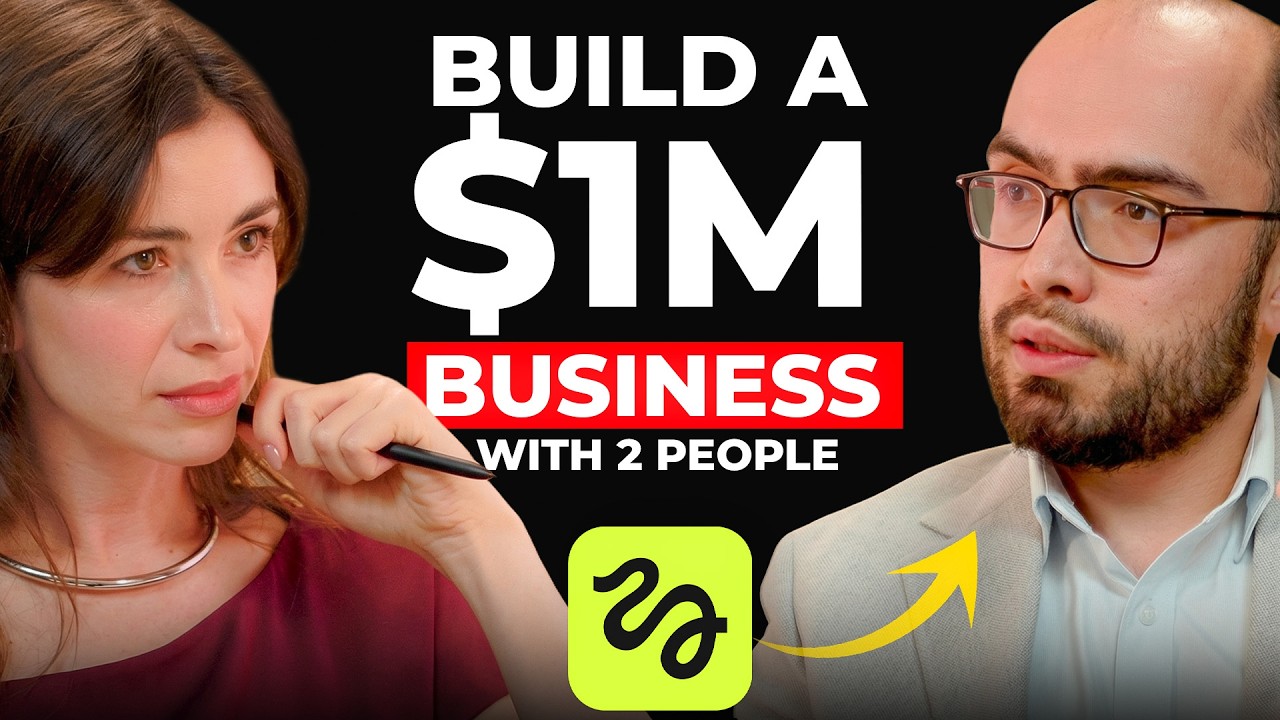
Alex Mashrabov is the founder and CEO of Higgsfield AI, an AI video and image generation platform that reached $200M in annual recurring revenue within 9 months of launch — a growth rate faster than Slack, Zoom, or Dropbox. Before Higgsfield, Alex accumulated deep experience in consumer technology and product development, which informed his customer-first, rapid-iteration approach to building AI products. He is a vocal advocate for lean founding teams, bootstrapped growth, and treating AI as the next industrial revolution.
Marina Mogilko: I have an amazing guest today. I am so excited to learn from you. Let's get very practical right away. You built Hicksfield and achieved $200 million in revenue in 9 months. Let's imagine every—I don't want this to happen, but let's imagine a scenario when you have to start from scratch tomorrow and you have 90 days to launch a business idea. From what you've learned with your experience at Hicksfield, what would you do?
Alex Mashrabov: I think it all starts with maybe a team of two. Someone who is a builder who can go within 24 hours from idea to a product. And now it all becomes possible. There are so many databases, there are so many payment systems and so on which simplify creation of MVP. And then someone as I call it a go-to-market person who has this natural empathy, maybe, or understanding of the sort of target distribution, whom they're selling to, and who can come up with interesting kind of new content formats which can resonate with the target audience on social media. And I think this is a very different skill set from the marketing roles of the previous decades.
Marina Mogilko: And how many times should they be ready to iterate? How many ideas?
Alex Mashrabov: For example, for us last year we were iterating every day. So it was six days a week and every day we were putting new product release as we were trying to find workflows and use cases which have high frequency and which matter for our target audience. And then once the technology gets there, it's important to develop sort of the workflow which is easy enough but gives enough configuration as well. This dilemma of the perfect interface is still not solved frankly. So this is another reason why we embrace daily iteration. And on top of all of that, every month the whole industry resets. They completely push the boundaries in terms of the capabilities. There are probably let's say five leading research labs and each lab is pushing massive updates every quarter. So at some months we have even two major updates and it typically requires substantially rebuilding the whole product around those models. So it's an exciting time today because product builders like ourselves at Hicksfield, we just try to evolve the product so that it highlights the best possibilities of these models to our customers. But it's a constant race.
Marina Mogilko: Yeah, it sounds like a very challenging race and I think you mentioned that last year was one of the hardest for you when a lot of things were not working. Can you talk to me about that one thing that actually worked in 2024?
Alex Mashrabov: In 2024, we really started from the mobile apps and things were not working well because retention for mobile apps is relatively low. Things drastically changed for Hicksfield when we started to constantly iterate with creatives and we just asked them a very simple question: "Did you see this video? This was a cool generated video." And they said, "Oh no, how is this possible? What's the cost?" And we say it actually costs maybe less than $500 to make this video. And then we ask, "Did you actually try these models? What's your experience with AI?"
Obviously, everyone tried AI by then. Even by maybe February last year, everyone tried AI but everyone had some issues with that. Back then we realized that the core limitation was around camera control. A lot of creative directors really want to control all the camera effects, camera angles and so on. Back then there was no system to achieve that. So the initial traction of Hicksfield AI came from these camera controls which we implemented on the engineering side based on the feedback from creatives.
Marina Mogilko: So how many interviews did you have to conduct to come up with this feature?
Alex Mashrabov: This is a very good question but it kind of puts me on a weak spot frankly because we interviewed eight people—eight out of eight said the same thing. We talked to everyone from Hollywood-level movie directors to regional producers of commercials. Everyone had the same feedback.
Marina Mogilko: And how did you select those people? Were they customers already or you just wanted to talk to people in the industry?
Alex Mashrabov: Actually, this was probably a challenge because we wanted to talk to people who we don't have a very close relationship with, just to get unfiltered opinion. But the feedback was very consistent. Everyone was missing these camera controls. So that's what we delivered in March last year. Then in April, we delivered a library of visual effects. And then I think in June, the industry completely changed. We saw the emergence of AI-native marketing agencies. So essentially, those agencies completely go end-to-end with AI and very often they try to bypass incumbent tooling like Adobe, for example, and go end-to-end with AI. On one side, they are very limited because AI capabilities back in June were a little limited. On the other hand, they drastically improve their margin profile and they kind of show their clients that they can build ads within days. A lot of brands actually want to have constant content flow on their socials and they want to embrace AI. And then from June to December last year, this new industry of AI-native agencies completely exploded.
Marina Mogilko: But basically, you said the start of your growth was the multi-angled camera view and it came from talking to people in the industry. I love that. And also the number eight is actually very consistent from what I'm getting talking to other founders. It's normally like 12 to 20, but it's not too many interviews because I feel like a lot of people think they need to talk to thousands of people to figure out the problem, but it's actually like around 10 interviews.
Alex Mashrabov: Yeah, absolutely. So eight people who actually helped us shape the product, and then I think we hired four of them.
Marina Mogilko: Oh, that's great. Yes. So now you have this feedback loop within the team.
Alex Mashrabov: That's awesome. And that's how we realized that probably the best products in creative AI are going to be built in symbiosis, in collaboration between engineers and between creators. So today, roughly 40% of our team of maybe 40 people are engineers, and maybe 40% are creators.
Marina Mogilko: Like you said, two founders, right? One is technical, one knows the consumer. It's basically reflected in your team. Okay, let's get back to that tough year because I feel like for a lot of people that's what they're scared of. So when you were building this and nothing was really working, and then Google releases the new video model, did you ever think about giving up on that particular market and starting something else because this was getting so crowded?
Alex Mashrabov: I think we were committed to figure this out. There are two reasons why we had conviction. First, prior to that I was at Snapchat. I was running Genie there and I saw the uprise of TikTok and TikTok became a top-five app in the world. And it's unprecedented because it's not a messenger, it's not social media. This was a strong signal for me that the needs of social media creators are simply unmet in the markets. And the second reason why we had conviction: we constantly heard that creators feel burnout from feeling pressure to record multiple videos a day for socials with their own face. Mr. Beast, he spoke very openly about that. But I think that's the primary challenge for the whole industry over the last four or five years. And then what was surprising to me is that advertisers have the same problem. Most of the advertisers talk about mid-market brands, and they can be spending hundreds of millions of dollars on marketing and they don't have any production team.
Marina Mogilko: So you chose the right part of the market. This is what I'm hearing. So I feel like for every entrepreneur who's watching, when you see a big opportunity in the market, you also have to spot who's paying the most, not just go after each user, right?
Alex Mashrabov: Absolutely. We live in a very interesting era where all the powerful companies try to give AI to everyone literally—Meta, Google, Microsoft, OpenAI, Anthropic, ByteDance, and many more. I think each of those companies wants to give AI to all its customers really. That's why startups have to have a more nuanced view of the world and have a more nuanced set of customers. And I think startups today are sort of incentivized to stay cash flow positive and build real business from day zero. This is what I see across Hicksfield and other top application AI companies. So I think this also creates a very interesting dynamic: the target audience should be maybe tens of millions of users who are willing to spend hopefully a couple thousand dollars a month. So it is not for everyone, but the delivered value should be so strong, so the product should be so good, that it kind of sells itself.
Marina Mogilko: I love that. And I love that you have a concrete number: $2,000.
Alex Mashrabov: Yeah, $2,000. I'm not sure like with Hicksfield, for example, this is the core metric which we are tracking—like how much of the value we believe we provide, which is more like through user interviews, but also how much we charge users annually. So this is one key metric and we are not chasing just monthly active users, for example, because the monthly active users number can be inflated through some viral effect. Monthly active users doesn't really speak to the frequency of usage and the value delivered. So that's why for us, really daily active users and average ACV—average contract value—those two metrics are the most important ones.
Marina Mogilko: One of the reasons I was so excited to sit down with Alex is that our team has actually been using Hicksfield for a while now. My producers and editors absolutely love that all the top AI models are in one place. Suno, Runway, Pika, Genie, Claude, Sora—and I love that they don't need 10 different subscriptions. And it's kind of incredible. Alex just told us that last year they were shipping a new product release 6 days a week. And now everyone knows them, but they haven't slowed down. They keep launching new features and one of the latest ones is Soul 2.0.
Soul 2.0 is Hicksfield's own image model and it's not like anything else out there. Most AI image generations, you type a prompt, you get something that looks fine. But Soul was built specifically for creative work—fashion, editorial, content. It actually understands aesthetics. You give it a reference photo and it doesn't just copy it. It reads the lighting, the grain, the mood, the era like a creative director would.
There are three models. So that's the core model—you prompt, you get a beautiful image with real aesthetic awareness. Soul Reference, you upload a reference and it generates new images that match the vibe, not just the composition. Same visual DNA, different shots. And Soul ID, you upload 10 or more photos of yourself. It learns your face structure, skin tone, expressions. Then it generates you in any style. Y2K, editorial, film photography, Polaroid—20 different presets at launch. And here's what actually got me: you can specify the camera medium, say shot on Kodak Portra or disposable camera, and it changes the grain, the color science, everything. It doesn't slap on a filter. It actually shifts the entire feel of the image. And the same thing works with color. They just added hex colors, so you can pull the exact palette from any photo and apply it straight to your generations.
Now, let's get back to Alex. Can you give advice to people who are watching who haven't started yet, but they haven't started because they think a large company is going to take over? How should they think about their defensibility?
Alex Mashrabov: I think each company can really keep their focus on maybe two or three top priorities. Interestingly enough, people like to say about Anthropic that their major success from MCP and Claude didn't come from top-down, but really bottom-up. And the Claude success was not sort of planned. And I think it's true that like these large companies, they definitely can benefit a lot from applying a top-down approach to two or three initiatives and really consolidating all the resources to make the most progress there. But I just think it's the next industrial revolution. It's probably more powerful than the internet. So the number of products and ideas to be built, I think, just overwhelms the number of ideas which OpenAI or Anthropic can push internally. That's why I would encourage builders to build, especially today when a quite small team of maybe 10 people can build high-scale products.
Marina Mogilko: Do you think there's a certain gap in time when we can build? So, for example, I've been hearing a lot on social media that we only have two years to build something new because then some companies are going to reach AGI and it's going to be impossible to find a gap in the market because those companies are going to be filling those gaps.
Alex Mashrabov: This is a good question. We definitely make tremendous progress as an industry to automating work in the digital world, and for sure maybe next decades there are going to be a lot of applications of AI in the physical world. It's difficult to forecast how much progress we're all going to make there. But this decade is definitely the era of the digital economy completely changing with AI. That's for sure. I really don't want to believe in the future when there are going to be maybe three labs who have the best models and these models controlling all the world. This could happen. That will be a very difficult future. So I would try to stay optimistic and encourage everyone to stay optimistic and really focus on building and delivering value.
Like, for example, I recently spoke to a very large, very very large property management company which actually uses Hicksfield to advertise their buildings, their apartments, and so on. And no one is building for this industry. In this industry there is a very specific workflow of a customer. The customer needs to learn about the property, then they need to go to the website and get all the details, then they need to call, then they need to show up, then they leave a deposit. And the whole customer journey. No one is actually building solutions specifically for this industry to cover this journey end-to-end with agents. And the reason why agents are going to deliver a lot of value in this specific business is that customers who want to maybe rent an apartment, especially at certain price points, they want to make a decision rather quickly. So every day of delay, every day of just moving from one stage to another, is just lost revenue. And this business owner just said to me that no one is building for their industry. And I'm confident there are many more examples like that.
Marina Mogilko: Yeah. So, "riches are in the niches," as they say. From your experience, when you pitched VCs with another AI idea, what makes a pitch stand out these days?
Alex Mashrabov: I think today there is definitely fear that OpenAI, Anthropic, and other labs are going to just be very acquisitive and try to expand their product offering to multiple different verticals. Pretty much every week there is a "Claude for X" launched and stocks go down. That definitely happens and that creates a lot of fear. And I would just say that the core insight for me personally was that most of these hot and hyped AI companies are actually cash flow positive. Maybe it is a wrong mindset to go and raise venture capital today. I think there is plenty of pre-seed capital available today, but I'm not sure everyone needs to raise Series A, B, C, D, and so on.
Marina Mogilko: How much revenue did you have when you raised your first round?
Alex Mashrabov: For me with Hicksfield AI, it was probably easier because I had a previous exit and we basically raised $16 million without having any revenue, just maybe having like a million users for our mobile app. But this is not exactly the way how I would recommend building today. I would recommend focusing on bringing the first dollar by day 30 of product development and maybe $1 million ARR by day 90, and then deciding if someone needs VC funding or doesn't need. I mean, a lot of businesses can really scale to tens of millions of dollars today profitably with AI, and for such businesses there is no need to attract VC funding. I can give you a very simple example. There are so many websites that just allow people to make professional photos—like for passports. Many of them make tens of millions of dollars. None of them are venture capital-backed businesses.
Marina Mogilko: Well, and you said something: $1 million by day 90 ARR, meaning like 80K a month.
Alex Mashrabov: 80K a month in three months. That's a lot. And so the playbook to achieve that is basically generating ads and launching them and testing whether they're landing with your target audience.
Marina Mogilko: Right. I think paid ads are very difficult today.
Alex Mashrabov: I think a lot of distribution comes through organic social media and creator integrations. And just make sure that by day 30 there is monetization in place and then there is a way to constantly grow revenue to let's say $1 million by day 90. Many successful companies scale very quickly today. Just different verticals have different capacity. Some verticals the ceiling could be just 50 million. In other verticals, 1 billion. In other verticals, like 100 billion.
Marina Mogilko: Any tips on landing first customers in the first 30 days?
Alex Mashrabov: Initially, at least last year, Twitter has been the social media where distribution starts from. It starts from small communities. Then it goes to AI news pages on X. Then from AI news pages on X, it goes to Instagram news pages. Then from Instagram news pages to creators, then it goes to Telegram and like other social media. That's what we have seen with Hicksfield and with many other products as well—they went through the same sort of journey of popularity and coverage through various social media, but it all originated on X. I think now it's being changed today. A lot of hype—a lot of companies they sort of try to use X to boost their products, so the signal-to-noise ratio just drops. Twitter becomes less relevant, but still it's the main place for new AI product launches.
Marina Mogilko: That's awesome. I'm still trying to crack the X strategy. I feel like if you add a word like "breaking" or just in to whatever you're posting, staying at the beginning, and it should be in top slug, then it performs.
Alex Mashrabov: Or just something should be like "closed" or something like that.
Marina Mogilko: Yeah. Just wiped this out of the market. Yeah, it has to be very sensational on X. But you're so right. I've heard so many, and I know a lot of creators who built their whole email newsletter—1 million subscribers—just off viral X posts.
Alex Mashrabov: That's amazing. I love this life hack. Thank you so much. Although this has been the primary life hack of 2025, and I do believe that the media evolves itself as well. So 2026 could be different.
Marina Mogilko: I always see LinkedIn on the rise. So maybe LinkedIn.
Alex Mashrabov: Maybe LinkedIn.
Marina Mogilko: Your previous company—you sold it for 166 million. Were there any key learnings from that business or mistakes that you made that you will never repeat in this one?
Alex Mashrabov: It's like "never say never," but one of the key learnings for me and the key takeaways was to embrace meritocracy. Sort of like, I'm 30 and I feel sometimes that I'm quite old for this new era of AI. A lot of new ideas in Hicksfield today come from fresh grads, maybe 23, 25, who sort of maybe never worked in a large company, who were doing like freelancing with some AI coding tools, who were doing AI coding before the term "AI coding" basically. And they just think differently. And I think that's sort of maybe the right mindset. So traditionally in any corporation, those people would simply be people that no one would just listen to. And the same applies to the creative role. So there is definitely some resistance from people who especially build, let's say, large Hollywood projects—"oh, AI is dangerous, it's not authentic." And in the same time, it's really exciting that for many, many young people, AI becomes a social elevator. And I sort of strongly relate to that personally because for me I had to do a lot of competitive programming—you know, like, who solves more problems within like five hours? Everyone in the world competes. So this was a social elevator in 2010, maybe, and this applies both to creative and to software engineering as well.
Marina Mogilko: I love how you said that AI is a social elevator because I feel like social media was the social elevator for me. Now it's the era of AI. I think you mentioned that video models could be a path to AGI and that you're also building a world model. Can you talk to me about that? And for everyone watching, I just wanted to explain—I was just in Davos and everyone was talking about LLMs having a ceiling because basically, just describing our world with words is something that we're used to, and there's a lot of information on the internet. But understanding the physics is the next level, and once we understand the physics, then we're going to have robots walking around our house and doing chores, if I'm explaining this correctly.
Alex Mashrabov: Absolutely. I think Demis from Google and Elon from xAI, they started this narrative, and definitely they are top influencers in the space. That's why now the narrative goes to the masses, to everyone. It's still unclear if that's sort of the path to AGI, although that's definitely a path to advanced robotic systems. I think Elon proved to the whole world that self-driving cars can work really well through just cameras. And I think the same logic is going to apply to more advanced robots as well. That's why developing perception and visual understanding is critical for the next wave of robotics, and it's a top priority for a lot of research labs. It's the next frontier. And there is no other way to improve video generation without visual understanding.
Roughly, people like to say that in one minute we can read 100 words. One minute of video can be described with maybe 10 to 60,000 words. There is just so much going on.
Marina Mogilko: So where do you see yourself in two years? Are you still working on videos? Because I saw Menlo Ventures announced their investment in you and they said that Hicksfield is building the next world model. Do you feel like your focus is going to shift to that or you're still going to stick to the marketing with video?
Alex Mashrabov: I think what differentiates us from many others is we are from day zero focused specifically on short-form content. And I do think that a world model is going to change the way how social media content is made. So for example, the next decade is going to be the era of interactive media—basically, when games and videos are sort of blurred in like one experience where it's kind of "choose your own adventure." So a lot of marketing is going to go this way, especially kind of premium marketing and customer loyalty programs. I think this decade is all about supercharging creators and marketing with those models.
Marina Mogilko: You said you're seeing customers with marketing budgets over $100 million, 90% of their ads are AI-generated. As a creator whose 90% of my revenue is from large corporations through their marketing budgets, should I be afraid?
Alex Mashrabov: This is a good question, and this is definitely where we should make sure that video AI can help personalities. What I would love to see is that creators like you and Mr. Beast and so on who are sort of AI-native start to make like more channels and just expand their media presence and be like a whole media empire. So the next media empire is going to be built maybe with like 300 people, 500 people, and be worth like $10 billion. So that's on the one side.
On the other side, what I see personally is that essentially this high-scale AI content creation comes after maybe a platform like TikTok marketplace frankly. So in the past, those brands, they could just hire sort of even programmatically thousands of creators through TikTok marketplace just to do kind of these templatized videos like "I use this product, it's all good, go buy that." So this entry-level marketing definitely gets democratized. Although, in my opinion, as we are seeing a lot of AI slop on social media and so on, the genuine connection and understanding of audience now matters more than ever. So there are going to be a lot of average and above-average content on the socials. And I think this is happening one way or another, and just deep understanding of the audience and authentic approach matter more than ever.
Marina Mogilko: Okay, so you think social media ladder, social media is not dead?
Alex Mashrabov: Definitely not. I just think that authenticity is going to matter a lot. And the way how I think about that is: if let's say top creators now can make their own shows, their own movies with AI, and creators can drive a lot of traffic, that's going to affect like streaming business a lot. I think the revolution is going to come at every level. Although I think clearly people who already understand their audience, who have an authentic approach, those people are definitely going to be the winners.
Marina Mogilko: Okay, my last question: for someone who's watching this, still has fear like "this is moving so fast, I don't know how I can start. I started something today, it's outdated by tomorrow." Can you give them one piece of advice so they can start?
Alex Mashrabov: First, I think I would start from a position that large companies—Amazon, Microsoft, Google, OpenAI, Anthropic—I think they're all relatively well-positioned to be winners in the AI era as they simply control data centers, GPUs, and so on. And I'm not sure there is much insurance policy for everyone else, regardless, right?
Marina Mogilko: Yeah, I do think that there is a lot of value in these companies, but I mean for a lot of others, right? I mean, we see the selloff across the US, we see the selloff across cybersecurity, and then there is an ultimate question: if I want to basically depend on someone else to figure out AI strategy, or I want to embrace AI myself and benefit the most? I think that's a personal question for everyone. And as we all know, these technology revolutions are both fair and unfair. I think in the long term, every technology revolution is fair and GDP per capita and quality of life goes up on the horizon of 10 years. On the horizon of like 3 years, I think it's extremely unfair because the market just loves to pour money into companies which are winning, and companies which are not winning, they immediately go down.
Alex Mashrabov: But in the short term, I think that it's going to be fair because people—both on the creative side, marketing side, engineering side—those who are embracing AI, they can propel their careers so quickly. In the end of the day, net it's going to be net positive. Although I think individually, we all just need to think: how can I personally benefit the most from AI? How can I become more efficient with AI? How can the value of my skill set actually grow with AI? And this always requires using those agents and various AI models several hours a day to build this intuition.
Marina Mogilko: Let's give them a homework task. What should they do right after watching this video? Which tool should they start using and how?
Alex Mashrabov: For me personally, I am an immigrant. So, you know, it just takes quite a bit of effort to come with a logical linear storyline. Claude 3 Sonnet became my coach. Really, this was the first "aha" moment for me. The second "aha" moment was around Gemini 3 Pro model. So I felt that my economic productivity really depends on like how much I use Gemini 3. These capabilities of the model which can process voice, which can make images, but which also has deep reasoning capabilities and deep research—this was mind-blowing to me. So that's why I feel that my economic throughput really depends on how much I use Gemini 3 today.
Marina Mogilko: Do you use it to make decisions about your company—like strategic operations?
Alex Mashrabov: I really feel that communication with humans becomes a way more important skill set for me because a lot of other decisions, I'm sure Gemini 3 and Claude are going to be better than myself. AI is not yet good at communication. So that's where I think I try to put a lot of my personal emphasis.
Marina Mogilko: I think other than that, a lot of processes can actually be built with AI. So just human-to-human communication and sort of conflict resolution and maybe goal setting.
Alex Mashrabov: Yeah. And like number-driven goal setting, really, is where I put a lot of my personal time. For everything else, I'm trying to evolve Gemini as much as possible, but also use Claude for Excel, Claude for X—like, for example, Claude for cybersecurity—as it really increases the productivity.
Marina Mogilko: Alex, thank you so much. It was amazing. I'm looking forward to reading your comments. What was your key takeaway and what you're going to do right after this video?
Alex Mashrabov: Thank you so much. Thank you.