LinkedIn founder: how to get ahead while others lose their jobs | Reid Hoffman @reidhoffman — Silicon Valley Girl Podcast
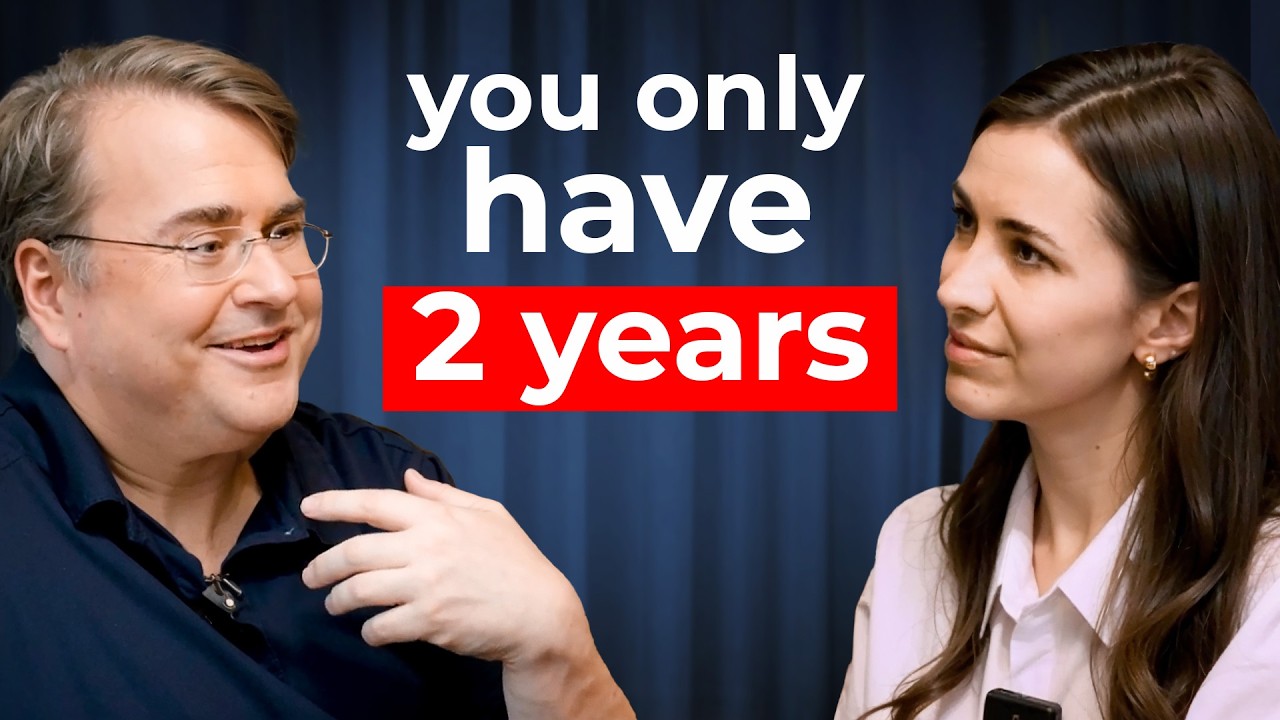
Reid Hoffman is the co-founder of LinkedIn, which he built into the world's largest professional network before its acquisition by Microsoft for $26.2 billion in 2016. He is a partner at the venture capital firm Greylock and an early investor in companies including Airbnb, Facebook, and OpenAI. Hoffman is also the creator of 'Reid AI,' a digital twin designed to extend his ability to mentor and advise at scale.
Marina Mogilko: What's going on? Like, should we be afraid?
Reid Hoffman: I always recommend hope versus fear and curiosity and optimism versus paranoia. But it doesn't mean that it isn't painful to do the transition. So yes, AI tools will be available in a small number of years for everything, and there'll be AI tools for not just the thing I've created with Reid AI, but like real-time interaction with Reid AI and all the rest of that. And that will happen. But what we should be doing is figure out how do we add our own creativity? I mean, you're one of the creators and everyone else, how do we add our own creativity and amplify ourselves with the tools? So, for example, of course you could have an AI just do all your short editing. I bet you the AI doing your short editing is not as good as the AI plus a human doing it. A human using it can now do a whole bunch more than they before, and they might be able to say let's create 15 different versions and like test them to see which are good. All of a sudden you have that acceleration of superpower.
Marina Mogilko: I'm very worried. Sometimes when I look at the content AI generated, you know, some people are getting replaced. Like, editors used to cut those short videos. Now we use an app to do that.
Reid Hoffman: Fear is generally best converted to curiosity. That doesn't mean it won't be difficult and that won't be learning new things. Because AI will be learning new things and becoming better and better. That's part of the reason why I encourage people to go play with it, go try it. Because as they realize it, they go, oh, I can still do these things using AI. So, for example, if I'm writing an essay, as opposed to starting with a blank page, I'm probably going to start with a GPT-4 prompt, right? And say, hey, I'm thinking about this, this, this, this, and this. I got this. Okay, now this is what I'm going to start working from in terms of how to do it. And that, by the way, just accelerates me and makes my ability to bring in my intelligence as opposed to having to type a lot and stare at the blank page. I can move faster and get to more interesting things. So it's a be curious and hopeful, but doesn't mean don't expect, you know, potholes, transitions, difficulties. Those will be there too.
Marina Mogilko: There are some skills that we need to learn in the next couple years to not be left behind. Obviously, like, testing apps, but also I've heard from someone that it's getting a lot easier to code. Like, I can learn just some basic things and use the Copilot tools, and they will help me. Would you suggest doing that or just wait another couple years when we don't even need coding and we just talk to AI?
Reid Hoffman: So I think within this year, 2025, it will quickly become that every engineer is using at least one Copilot agent, and that's part of what professional is. I think perhaps by the end of next year, 2026, all of us will have a lightweight coding assistant. That doesn't mean it'll code the great iPhone app for you, or it will invent that game that you've been thinking of. But it will help you do things like research. Like you say, hey, bring these multiple information sources and documents and put them all together and generate a list of questions and then generate some provisional answers. It will help you with that. And then the coding element will help pull all that stuff together, and that will be part of superpower that you and I will now have. Generally speaking, AI, I don't suggest waiting. Because part of what you want to be doing, just like any new technological revolution, whether when YouTube was happening, when the internet was happening, the folks who go and adopt and play with it early then have a differential edge in the change that it means in the industry and their society. So even though three years from now the coding tools and agents will be much better than they are now, the people who started playing with them now will probably be the people who know how to use them and deploy them much more comfortably early.
Marina Mogilko: We're talking about like two years. Yes, of course, AI will not be able to come up with an app. But I'm thinking that in 15 years I will tell AI, like, come up with a business idea, code an app or a website, start selling, figure out the marketing strategy. Like, what should I tell my daughters? What should they be learning now? Should they be acquiring academic knowledge or just learning social skills? Because this is what we'll have left for, like, years?
Reid Hoffman: Well, I think it's always good to learn social skills. But for example, take that thing over where you say everyone was going to GPT-4 and say give me an idea for a lemonade stand. Well, it'll give them all the same idea. But it has the memory feature, so it's well, it has the memory feature for you. It's not necessarily taking that memory feature for other folks. It depends a little bit on how the learning and training works.
But generally speaking, say all a million five-year-olds were equally provisioned with GPT-4. Which lemonade stands are going to work well? The five-year-olds who think, oh, I should make my lemonade stand with Hello Kitty, right? Like, I know my neighborhood. I know my people really like Hello Kitty. So I'll go in and I'll prompt it for what would a Hello Kitty lemonade stand look like? And so that engagement and learning how to use the tool, just like learning how to use an iPhone or learning how to use a computer, learning how to use Photoshop and everything else, are now going to be much easier. Because one of the things AI is, it's like the meta-tool. So it'll, as opposed to having to learn all the details of Photoshop, you can just use the AI to say, well, I'm really thinking about something that has this kind of look, this kind of light effect. Can you do that? And it'll figure out how to do that for you.
Marina Mogilko: Yeah. That kind of visual thinking, or creativity, or tool use, is the thing that you also want to be instilling with a direction of always be learning. But fundamentals like mathematics, basic coding, you still think that's important?
Reid Hoffman: Yeah, it's about the mindset and the way we think. Yes, exactly. It's a little bit like when people were terrified that calculators came up, that people would stop learning math. And it's like, no, no, no. But you stop learning the mechanics of how I carry the one and do all the rest of it. I understand how it works, but I use the calculator, or now the computer or the phone, to do the math. But I still understand math. I still need to understand math. I still think about math in different ways. I'm just not the job of what I am as a human calculating machine. That job doesn't exist.
Marina Mogilko: Do you think we'll come to a world where we don't need that many people working?
Reid Hoffman: You know, it's possible. I don't think it's actually in the near term. We see the trends like Silicon Valley working four days, people are like already preparing for the weekend. But none of the companies that I'm working with are working less than 80-hour weeks.
Marina Mogilko: Okay, but those are startups?
Reid Hoffman: Yes, but bigger companies are also working their way back through the pandemic. It's part of the reason why they return to office and all the rest of this. In terms of whether we need that many people working, I think that the, you know, for example, Germany is an example of an industrialized society that went to a very rigorously maintained number of hours per work week. I think it's possible. But I think because human beings tend to want to go do epic things, work really hard sometimes, make themselves wealthy, spend a whole bunch of time on a YouTube channel, et cetera, et cetera, I think a large number of people will still be very engaged. So I don't think it's necessarily a quick general retirement.
Marina Mogilko: So you don't think, because my thought was like, if AI continues to develop that fast, we're going to have universal basic income and then some people are going to work and some people are going to just enjoy lives? Do you think that might be reality?
Reid Hoffman: Look, it's possible. If you got to a point where you had enough, you know, this science fiction Star Trek kind of future, where you had enough robots that were producing everything, producing all of our material needs, robots who put your kids to bed if you're hungry, it's possible. But, by the way, if you even think about how long it will take to build all those robots, well, like, I don't know it's so fast. Like, I've been in Silicon Valley for ten years. San Francisco full of self-driving cars. Ten years ago I couldn't imagine that.
Marina Mogilko: Yes, although there's still a limited number of those cars. There's still many more Ubers and many more Lyfts.
Reid Hoffman: I'm just saying there's physical constraints in the creation of that world. That's one of the reasons why people are like, because I talk to the same Silicon Valley people you do, and it's like, we're going to have universal basic income in five years. Like, no chance. So do you think in our lifetime?
Marina Mogilko: Not impossible?
Reid Hoffman: Look, on one hand, there's all the physical constraints of building everything that matters: cars, clothing, houses, and all the rest of the stuff. But then also it gets to, you know, part of what the human impulse is, like we compete. You know, when a lot of people we work with and work alongside here aren't just content to say, well, I've got a house that's in downtown Berlin that's two bedrooms, you know, I want the big house in Aspen. And so that kind of competing still happens, and people will still have that as kind of an impulse and want that in various ways. And you see it not just in economics, but also, of course, in sports teams and all the rest of this and the attention economy and all of this. So I tend to think that there's also this human factor that isn't, oh, I'm just going to be happy, you know, reading books, gardening, et cetera. And so I tend to think that the kind of, we are all one nation of retirees or one species of retirees, I think that's almost certainly not the future. The question is how does it blend between it? And obviously, the people who are working hard want to have a differential reward for it. They want something that plays into it. That doesn't necessarily mean there isn't UBI, but you may even need to be what is called CBI, which is conditional basic income. Because in order to still be engaged in society, it's like, well, you can have a UBI, but you have to spend at least ten hours a week doing community service, doing something that helps the local seniors or helps the local schools, or something, so you're engaged in society and you're investing. It's really important for longevity.
Marina Mogilko: Yes, exactly. So what the shape is, I think, is still very, very TBD and further out than most of the technology visionaries will have. That makes me feel better. Okay, let's talk about entrepreneurship. I noticed, like, my startup, we build a search engine for study abroad programs. If you ask me now, like, would I build something like this in 2025? Of course not. I'd just build an AI bot. So it looks like a lot of business ideas, especially online, there's only like two or three months before OpenAI comes up with another model that solves your problem.
Reid Hoffman: Yes. Do you think there's a chance to build like a company that's bigger than the mega seven?
Marina Mogilko: Oh, almost for sure. I can continue to invest. I continue looking to do that. I think we're, you know, whatever count you have, five, seven, I think there will be ten to fifteen over the next five to ten years. I think we're broadening out that way now. You don't do it by building a company that is like, I'm going to build the new iPhone company. Like, I just have a new idea for an iPhone. Like, it isn't. Well, once a company is really established in its position, you don't actually take it from behind. What you do is the technology gives you a different angle and you start building from something else. Like, who would have thought five to ten years ago that Nvidia would be the—
Marina Mogilko: Oh yeah, right.
Reid Hoffman: So it's different angles by which it happens now. And the fact that there's going to be a limited number of what are called frontier models, the largest scale AI models, doesn't mean there aren't room for mega AI startup companies. Because it's not only the technology. The model is not the only thing that matters. It's kind of like, how is it productized? How is it integrated into people's lives? What's your go-to-market strategy? How do those things work? And you can still create businesses that have network effects, marketplaces, other kinds of things that can, in fact, be very big. So I, you know, we at Greylock, myself, we're kind of looking at all of the things that could create the next big mega companies. And that's generally speaking what we're looking to invest in now.
That being said, if someone came along now and said, I'm going to try to build the next OpenAI from scratch right now, he'd be like, well, there is an OpenAI that's doing a really, really good job. What should entrepreneurs look at? What industries? The thing that I had predicted, you know, fifteen months ago when I was talking to my partners at Greylock, is that we were going to see a whole bunch of enterprise apps. We're going to see coding apps, workflow productivity apps, legal assistance, medical assistance, tutors, all that all is great. And look, I'm happy to invest in a bunch of these things. It's not a billion-dollar company. Well, things don't start as a billion-dollar company. It's the question of how big, strategic, and economic do these businesses get?
So now, for me, I tend to like to be surprised by the entrepreneur who's thinking in a new direction that most people aren't thinking. It was like one of the reasons I like the first investment that I brought to Greylock was Airbnb, right? Because it's similar. Like, every literally, my partners, I was like, people are going to rent a room or a house from other people? Like, is this real? And that kind of thing. And so similarly, I like to look for those kinds of things with an AI. It's like, what's something about the use of AI that most of the entrepreneurs who are all heading towards doing coding assistance or productivity apps or new security paradigms haven't quite gotten? That's like that new way of thinking. And it's one of the reasons why, like, for example, when we're talking about your daughter, the role for creativity, the role for human understanding, humanities, and so forth, is still actually, in fact, very important. Because predicting what those markets might be, what people might want at scale, is extremely important. That's the kind of feeling of the markets, some that would be completely changed by AI. And that's the opportunity.
Marina Mogilko: Um, look, an obvious one is kind of looking at the set of different categories that people aren't thinking about, whether it's marketplaces or networks of various sorts, and saying, hey, can AI do something interesting here? You know, I don't usually when I'm ideating on ideas, say them, and it's okay. Of course, my top videos are like top ten business ideas, whatever. But it's just interesting where you're looking. Like, healthcare or education in general. We're talking not just about entrepreneurship, but like, in general, where do you feel like the biggest change is going to happen with AI? Like, what's going to be transformed?
Reid Hoffman: I'm hoping healthcare. Well, I think healthcare is an obvious and very important one. Think about it. We have the technology today to have a medical assistant on your smartphone that's better than your average doctor. That's available 24/7 to everyone on a smartphone. That runs it for, call it, a couple dollars an hour in terms of compute cost to run it. We should get that as soon as possible. That doesn't mean doctors are out of work. There are all kinds of things for doctors to do. Because, among other things, the app may say, hey, these are the three things in most probability from these symptoms. But then the doctor knows, oh, these are the things that I'm seeing in the symptom that you didn't tell the AI. That's actually really important. We need to look at that. There's all kinds of things. And a doctor can spend more time with patients because the AI is like, hey, look, I had this whole conversation with my medical assistant, and here's what I came up with. And they go, oh, well, let's spend more time on this one and less time on this one because that's all faster given the economics of it. So I think that's clearly going to happen. Should happen. Should happen as fast as possible.
Another one is a tutor for every subject on every age. And to make this kind of like a personal comment, like, I've always been curious to understand quantum mechanics better because, you know, we have this whole new world of quantum computing, and I'm trying to understand it. I can repeat the stories that we read, but understanding it in some depth is one of the things I've always wanted to do. Well, now I have a tutor that's infinitely patient. They can say, oh, here, here's the thing that you need to understand. These are the questions you have about the observer effect in quantum mechanics. And here are some of the ways to think about it.
Marina Mogilko: Yeah, that makes sense. Okay, I'm going to wrap up with two final questions. Can you tell me what are your three favorite AI apps?
Reid Hoffman: My three favorite AI apps. Um, I will say four, okay? In part because, you know, my own Inflection Pi has to be one of them. So all three, in addition, ChatGPT, from kind of like a research assistant. Midjourney, from the creation and thinking of bringing me into kind of visual imagination and being able to create things visually, which I never was able to do before. And then, you know, partially because I've been thinking a lot about how, as everyday people, we're all going to have a coding co-pilot, so I've been playing a lot with Microsoft's co-pilot and coding and getting myself back into that to understand how this is going to transform everyone's use of phones and computers. Yeah, and the fourth is yours.
Marina Mogilko: Yes. Inflection's Pie, which part of it was training a chatbot to be as good at EQ as it is at IQ, to be kind of engaged and warm in the conversation. And I think we've actually had a great industry-wide impact because, I think, as people have looked at it, they've gone, oh, that's really important. We're going to add some of that into what we're doing.
Reid Hoffman: Okay. And the last question is, because you're doing the AI version of you, which looks really realistic now that I see in real life, because then you showed me all the videos. Should everyone think about creating an AI version of themselves? And have you thought about like, have you had your opinion of your legacy changed once you've created the AI?
Marina Mogilko: Because it can live longer than you can live for years?
Reid Hoffman: Although at the moment, my AI agents live shorter than me because we're revising them. So right now they're actually shorter. But, you know, I do think that everyone ultimately should consider it. I mean, especially if you have kids and they have grandkids. And there may be something that's kind of it's like generations talking to each other now.
Marina Mogilko: Yes, exactly. So like that could be a very human-enhancing case. Obviously, folks who are doing stuff in media, like you are, like I am, that's very useful in various ways. And we've had Reid AI give keynotes at conferences and other kinds of things.
Reid Hoffman: Yeah, I was just at that conference exactly. And so I think that's another thing. Your front end is not the phone directly calling you, but you could imagine like your front end is your AI agent.
Marina Mogilko: I'm trying to remember. Are we like, they... oh yeah, I remember who you are. And it's like, oh, are we meeting for coffee tomorrow at two or three? Oh, it's three. Okay. And that could all happen with the agent. Or I really need to get to Reid right now. What's the issue? Let's talk about. Oh, wait a minute, this does sound important. Let me see if I can get them on the phone.
Reid Hoffman: That's awesome. Even like adopting someone's mindset. Because I sometimes ask ChatGPT, can you think like this person?
Marina Mogilko: Yes, exactly. That's very useful. Thank you so much, Reid. You gave me a lot of hope actually, because I was like, oh my God, AI is taking over everything. But it's actually enhancing us. And this is what your new book is about, right?
Reid Hoffman: Yes. And we're doing all kinds of little AI things to also enhance and promote it.
Marina Mogilko: That's awesome. Thank you so much.
Reid Hoffman: Thank you.