How I Made $50,000 on My Airbnb in 6 Months — Silicon Valley Girl Podcast
Entrepreneur, content creator, and founder based in Silicon Valley. Marina interviews the world's top tech leaders, investors, and innovators to uncover the trends, strategies, and mindsets shaping the future. With millions of followers across platforms, she brings a unique perspective on technology, business, and personal growth.
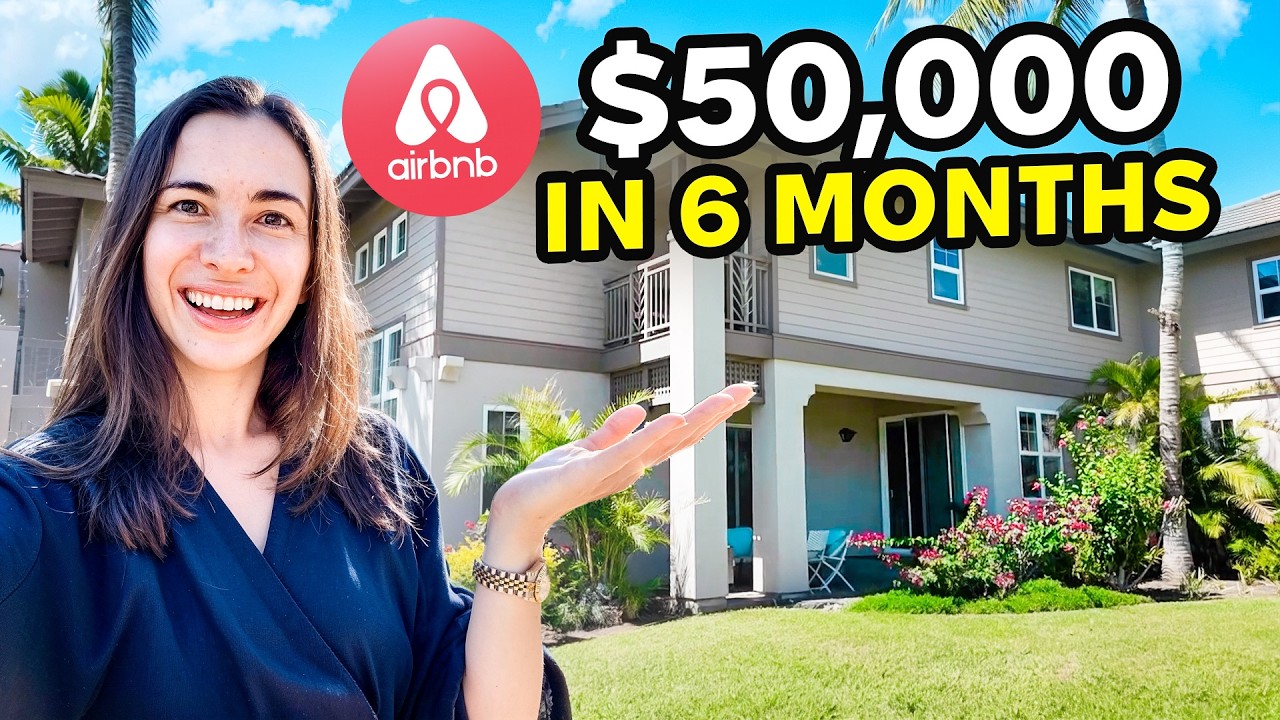
Marina Mogilko: In January 2024 we bought a condo in Hawaii. This is our second home and we're also renting it out on Airbnb. When I was closing the deal, I had people who DM'd me and texted me saying it's going to be the worst decision of your life. I remember a friend who kept sending me articles from local newspapers saying, "Hey, I'm so sorry you just bought this Airbnb condo because they just banned Airbnbs in Hawaii." You know how all the articles look when they want to scare people. There were some bans, but not on my island and not for existing Airbnbs. People were like, "It's going to be a nightmare. It's going to be awful. You're going to regret your decision."
It's been six months since we started renting it. We got it in January and then end of March we had our first guests. So it's been six months and in this video I'm going to share all of the financials—how much of the money that Airbnb generated we actually got to keep, if any. I'm going to go through financials, go through the journey, and hopefully this is useful for everyone who wants to become a landlord.
Before we dive into Airbnb analytics and ins and outs, I want to thank HubSpot for sponsoring this video. Before I get into numbers, I just want to tell you a backstory. I live in Silicon Valley in the Bay Area and the cost of real estate here is so high that we can't really afford to buy a house. I still really want to live here, but for the budget that we had, we couldn't really afford anything. We have kids who go to school, and if we're talking about Silicon Valley, if we want to live in a nice area with good schools in close proximity to all the founders and VCs, we're talking about at least three to four million dollars. Prices here are crazy.
My thinking was, okay, I can't afford my dream house yet, but I can start playing the real estate game and I wanted to start playing it as early as possible because real estate prices tend to only rise. There's this FOMO of like everyone is buying a house, so we decided that we're going to invest in a property that's going to generate cash flow instead of just putting our money into a house that doesn't bring any revenue.
The most important thing I've learned about finances is that planning and accounting are essential keys to success, especially when it comes to an investment property and projecting cash flows. Before buying our vacation rental in Hawaii, I carefully calculated all financial flows and risks. I basically have an Excel spreadsheet with dashboards for every project I take on, including managing personal and family finances. If you're not yet tracking your finances and the cash flow of your business, I highly recommend starting with a free financial planning template from the HubSpot team.
The free kit includes five templates to help you stay on top of your finances: a personal financial planning template, cash flow statement template, balance sheet template, profit and loss statement template, and financial projection template. Whether you're an entrepreneur trying to make sense of a balance sheet or a new grad sizing up your first 401k, these five templates will help you take control over your finances, even if you're just starting out. Tracking your personal finances is a great habit. Once I began tracking my own finances, I felt more organized and gained a clear understanding of my current situation and future goals—a crucial step in growing your income. Follow the link in the description to download these free templates from HubSpot. A big thanks to them for providing these resources and sponsoring this video.
Now back to my Airbnb financials. I started researching. I researched Florida, I researched California, I researched like all the places on Earth and then we met this guy who manages several properties in Hawaii. He said, "If you look at AirDNA—it's a website where you can see how different Airbnbs are doing—if you look at AirDNA, there are only a few areas in the US where you have 90 plus percent or 85 percent plus occupancy rate and you can still get a permit because in California, in some places you get amazing occupancy rates but you no longer can get a permit for a new property because of the new laws and bans. One of the places is the Big Island in Hawaii. Come over and take a look."
So we came over, we took a look. It was my first time in Hawaii. I fell in love and I was like, you know, this actually looks like an amazing second home. It's a five-hour flight from the Bay Area, which if you're watching from Europe, this is close. It's a direct flight. It's perfect. It looks like a perfect retirement place. There are so many people from the Bay Area and it's serene. I'm like, okay, let's look at the properties.
We started looking at properties and in December we found this three-bedroom condo. They already had a permit for it. They'd been renting it out on VRBO. They had great reviews, but they were not listing on Airbnb, so we decided to get it. There was another thing that affected my decision to buy in that area particularly. I really wanted a manager who I know and who I trust. This guy who manages our property lives in Palo Alto, so he's close. He's also a fellow Russian speaker, and I know that Russian speakers—he's from Kazakhstan, but I know that our people are all about hospitality. I didn't want this Airbnb where you arrive and you have really low quality sheets, the cheapest soap from Amazon. I didn't want that. I wanted to put my name on something that truly stands out.
We decided that we're going to do our best in terms of hospitality. He takes 20 percent of the revenue, but he's able to satisfy all of my needs. We provide a fruit plate for all the new guests, we provide extra cleaning, and he also helped me with light renovation. Because this was a big investment for me—it's over a million dollars—and I didn't have an extra couple hundred thousand to renovate the place. It's kind of from the 2000s. It's nice and livable. It's not brand new, but we still thought it's going to do the job. I actually like it. It's newer than the house where I live.
Okay, I'm going to start showing you the file that we have here. This is basically my financials. I'm just going to show you everything. Here you can see some costs that we incurred. Basically, this is February. We spent around $66,000 on getting a new couch, getting all the supplies, getting some rugs and paintings, and brand new kitchen supplies. Some of the things I was able to do through brand deals with certain companies. We did a brand deal with Nectar and they provided a mattress and a bed frame, which was amazing. Some of the mattresses were new. We also partnered with a furniture company and they provided a couple of items for the condo, which was great, but still we spent around $6,000 on renovation and I spent $2,000 to create the necessary legal structure.
From then on, we have the HOA, which is around $1,400. We have mortgage payments and we have taxes. Taxes are actually super high in Hawaii if you're renting it out—it's like 20 percent of your revenue. We bought all the nice coffee supplies and everything and it started. Let's look at the revenue. The summer was pretty good. In May, the first guests came—I think it was late March, early April—but there was no revenue in April because we get paid from the manager one month after. In May we got paid $817 after manager commission, then we got $6,000, then $7,000, and then this revenue that we got—so we got $6,000 here, $7,000 there. Did we get to keep it? Well, not necessarily. Let's look at the expenses structure.
First of all, we have taxes. Taxes in Hawaii are pretty high. You pay around 20 percent towards taxes only. Then we pay the HOAs, $1,400. By the way, these numbers are after our manager's commission and all the cleaning fees and everything, so that's already out. We only get the net from the manager. Then we have our largest expense, which is our interest on our mortgage. The thing with the mortgage is we have a 30-year mortgage on this condo. What happens in the first months is when you pay like $7,000 in mortgage fees, $6,500 goes towards interest, not towards your equity. You're basically paying the bank the first few months instead of paying for your condo, and this is kind of really upsetting.
If we look at the final result here, we're still negative after all the expenses. After taxes, this is kind of sad. If you look at the net profit, April we were negative, May we were positive, but it's not going to last forever. In a minute, I'm going to explain what's going to happen next, but you'll be surprised that August was actually the worst for us. We got paid $111,000 from the manager—$1,400 is for July, we got it in August—but then in August, our manager calls us and says, "Hey, your air conditioner is almost dead. In Hawaii, you can't really operate an Airbnb if you don't have an air conditioner, and yeah, it has to be replaced as soon as possible." I'm like, "Okay, what's the cost?" He's like, "$16,000." I'm like, "How long is it going to last us?" He's like, "Maybe the next 10 years."
When we got the condo, my husband went to Hawaii and he actually negotiated like a $40,000 discount with the owner because we already noticed that the air conditioning was almost dead. But still, when you actually incur that expense in that month, so we're basically after we paid for it in September, we were at a negative $9,000 because we had to pay for the air conditioning and it got us even more into the red zone.
So basically, if you calculate these numbers, we're actually in the negative. But let me talk about what's going to happen next. This was actually all in our financial model. We knew that in the first year we would lose up to $60,000 because of the way it works. We're mostly paying the interest, which is a 100 percent expense. Our Airbnb is still getting started although the occupancy rate was amazing. If you look at our listing, we are a rare find on Airbnb. If you look at the next months, September is fully booked and the average price is from $400 to $600 a night, which is pretty good.
Because of how the expenses look right now—mostly interest on the mortgage, the air conditioning, the new furniture—this year we were ready to lose up to $60,000. I think we're going to lose less. Next year we're actually going to lose money again. I think it's going to be like minus $30,000 or $20,000, but hopefully starting year three, when we would pay more towards our principal versus interest, when we will be able to raise our prices because hotel prices and Airbnb prices rise every year by three to five percent, and we're going to get higher occupancy rates, so starting year three we should be cash flow positive. This means our Airbnb income is going to cover all mortgage expenses, all the HOAs, all the taxes.
But for now, it is what it is. And I wanted to be super transparent about the numbers, especially for those who are just thinking about buying an Airbnb. Honestly, emotionally it's just so cool. Financially, in the first two years, it doesn't look good. Like, it's not something that's going to generate profits right away. You're going to have to do some work. You're going to have to do more investments. But there is this emotional aspect to it as well.
This is actually my first property in the US and it just feels so good that I am finally participating in this real estate game. That's the first thing. And the second thing—one of our friends is there right now and it's her birthday and we were able to just gift this stay to her. I was like, "Yeah, just go to our home in Hawaii and spend your birthday there." We are very close to Hilton on the Big Island and they have dolphins there, and she just texted me that this is her best birthday because she's in Hawaii, the condo is amazing, so close to dolphins, so close to everything.
Emotionally it gives me so much satisfaction and just this feeling that I have something of my own. Yes, I'm renting it out and I'm super happy that it's also in business. We always have this place where we can stay as a family. For me as a woman, it's super important.
I hope this video gave you some clarity about the numbers and the emotional aspect of running an Airbnb. By the way, from the time perspective, we don't really do anything. Our manager does everything. They take care of everything for 20 percent, which I think is totally worth the cost.