Stanford AI Expert: 71% of People Won't Survive the AI Shift — Here's the 30-Minute Fix — Silicon Valley Girl Podcast
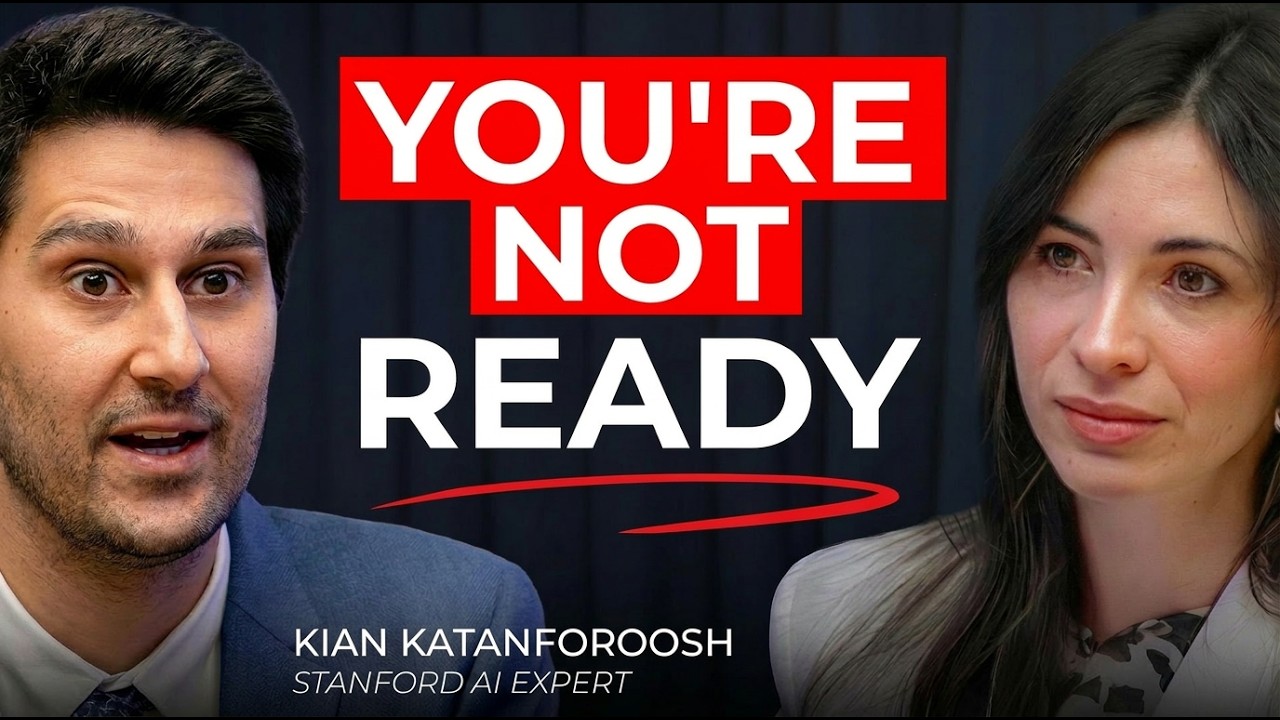
Kian Katanforoosh is the CEO of Workera, an AI-powered skills intelligence platform that has assessed over one million professionals on their technical and AI capabilities. He is a lecturer at Stanford University and co-founded DeepLearning.AI alongside Andrew Ng, one of the world's most widely used AI education platforms. Kian is a leading voice on AI workforce readiness, skill development, and the practical deployment of AI systems in enterprise environments.
Marina Mogilko: How often do you use AI? If it's not daily, I think you're generally behind.
Kian Katanforoosh: That's right. I'm a Stanford AI professor who built one of the world's top AI education platforms with Andrew Ng. Through my company, I've tested over a million people on their AI skills. And today, I have a step-by-step plan so you don't fall behind.
Marina Mogilko: What are the three moves everyone should make in 2026?
Kian Katanforoosh: Learn the foundations of AI. Assess yourself to make sure you're ready. Build a habit of learning. If you focus on one thing for a day, you probably are already in the top x% of the world. For a week, non-stop, you're in the top 10%. Focus on a month, you're in the top 1%. But to be in the top 0.1%, you will have to commit long-term.
Marina Mogilko: Let's start with your big idea. 2026 is the year of humans, but also we're getting a completely different narrative with a new model every week replacing jobs. How do you think we should focus on humans right now, and what is the shift?
Kian Katanforoosh: I think the shift that is happening is broadly due to the fact that people generally overestimate the impact of technology on the short term and underestimate what the technology can do on the long term. If you look at all the reports from foundation model labs like OpenAI, Anthropic, and others, there's a lot of task-level reports like AI is good at task A, task B, task C is getting automated. But actually going from a task to some human's job changing—a job usually being made up of hundreds of tasks—is not that simple. It can take decades. And almost every prediction I've seen since the launch of ChatGPT that "XYZ job is going away" has not happened. You know the famous one is the radiologist will go away and the drivers will go away, and then you see this meme of a radiologist driving to work in their car.
Marina Mogilko: You mentioned drivers. Do you have an estimate? Because if you go to San Francisco, there are almost no old taxis anymore. I don't really see them. So we see the replacement happening. But how soon do you think it's going to happen for drivers, for example?
Kian Katanforoosh: Well, you look at the rise of Waymo, Cruise, and all these companies in the self-driving space. They really started in 2014, 2015. So we're already 11 years into them having hired tons of engineers to build that problem. Even autonomous driving has been a decade of full-on research with people working so hard. So why wouldn't it be the same for the rest? I think maybe in the next decade we're going to start seeing less voice actors, less translators, maybe customer support is going to completely change. I agree fully with that. I just think people thought it would happen within six months, and it hasn't.
Marina Mogilko: So we're safe for now, at least?
Kian Katanforoosh: For the next decade generally, I think safety in a career comes down to learning velocity—your ability to reinvent yourself. The web has this metric called the half-life of skill, and it's going down. On average, a skill is not useful that long—it's two years in tech or AI. So you have to refresh yourself. And that's what makes you safe ultimately.
Marina Mogilko: Absolutely. And your data shows 71% of people misjudge their AI skill level. Can you give us some benchmarks? What does an AI-proficient person look like? What does their day-to-day look like? Do they start with just chatting with AI, or is it not writing emails by yourself or having AI manage their schedule?
Kian Katanforoosh: Yeah, I try to separate adoption of AI and proficiency. Let me give you an example. Adoption is like you use AI every day and I use it every week. You're a better adopter than I am. But it turns out that if we watch you prompt engineer and me, maybe your prompts are just simple prompts. When you look at what I'm doing, I'm doing a variety of techniques. I'm doing zero-shot prompts, few-shot prompts, chain of thought, prompt chains that are super complex that feed one into another, retrieval augmented generation systems that I built. My proficiency is higher than you.
Marina Mogilko: That's the difference between adoption and proficiency.
Kian Katanforoosh: Exactly.
Marina Mogilko: Okay, what you just said makes me feel like I'm a beginner because my prompts are really, really simple. If I want to sound like you in 90 days, what should I be doing?
Kian Katanforoosh: So, first, if you have 90 days, I would say first we need to establish the foundations. Take a few foundational classes. We can recommend some on deep learning.ai and other platforms. There's a lot of content out there honestly. High-quality content. Establish the foundation. Then you will get to a point where what will matter the most in AI—because the market is moving so fast—is that you're plugged into the network. So what I recommend generally is you go to X, you go to Reddit, you go to some of the machine learning popular newsletters, and you register for all of these.
Marina Mogilko: Can you recommend who you follow on X for the best advice?
Kian Katanforoosh: Well, if you go on my X and look at who I follow, you can follow the same people. But some of them are here. Andrew is a great person to follow—he has a great newsletter called The Batch. Richard Socher, Yoshua Bengio, lots of great AI scientists that people trust.
Marina Mogilko: That actually allows you to cut through the noise when there's so much noise. When I was in grad school, we would read papers that come up on arXiv, the website where papers are published. Today there's just so much that you have to find ways to differentiate signal from noise.
Marina Mogilko: Every time I scroll through my feed on Instagram, there's a new app and a company that just changed the game in this market. It happens every day.
Kian Katanforoosh: Okay, so we've established this. You follow the right people. What is the next step? Are there like top three AI apps that I should be using?
Marina Mogilko: Yeah, I mean, I recommend obviously Workera for testing yourself, although it's mostly used in corporations. Other than that, deep learning.ai has a lot of free content. It's really good. You also find that LLMs can help you learn. You can actually prompt the LLMs, but the bottleneck is people don't know what to ask the LLM. And that's where the assessment is so important. Because at some point, you're going to be pretty good at AI and you're going to hit a wall in front of yourself like, what do I do next? Am I actually that good? Do I know?
To give you an example, at Stanford we have a class on campus with a lot of students and we have the class on YouTube with the same content published, with a lot of views. Those students would tell you that the difference between them and the Stanford kids is not the material. It's that they don't know how good they are. Stanford students have friends at OpenAI, friends at Meta, friends at Google. They know how good they are compared to the bar, how much it takes to get a job there. But if you're somewhere in the world with no ecosystem, you're not plugged in, it's really hard. And so that's where the assessment is so important. It can tell you, "Hey, actually, you thought you're pretty good, but that's not the bar. The bar is actually higher."
Marina Mogilko: Top three questions that you should ask yourself to understand your level?
Kian Katanforoosh: How often do you use AI? If it's not daily, I think you're generally behind right now. That's a simple one. The other one is, think about 10 products that use AI that you encounter in your daily life. Can you come up with 10 products? Some people would realize, "Actually, I don't realize where AI is. Is it here? Is it there? I don't know. I don't have this ability to identify AI."
Marina Mogilko: You're probably behind.
Kian Katanforoosh: Yeah. When I say that, a lot of people have the same reaction.
Marina Mogilko: Okay, by that definition, I'm definitely not using AI enough yet. And honestly, for most teams, it's not a motivation problem. It's that there is no simple visual way to plug AI into the work they're already doing. Right now, AI usually lives in fragments. Cursor in one tab, cloud code in another, maybe a copilot or an OpenAI model somewhere else. That's exactly how my team used to work before we changed our setup. Ideas in one place, guidelines in another, code somewhere else, video editing on another platform, and almost no visibility into how it all connects.
That's why I got excited about partnering with Miro and their MCP server. MCP lets you connect your Miro canvas directly to the AI coding tools you already use. So instead of Miro being notes on the side, it becomes the central hub where your specs, diagrams, and context actually feed your agentic coding workflows. Practically, it changes two big things. First, you can take shared context—diagrams, docs, notes, system maps—and send that straight into your AI assistants to build better code because now Claude or Cursor has actual context from your diagrams and specs, not just a prompt. Second, you can instantly visualize that code as diagrams in Miro in a collaborative environment where the whole team can understand, comment on, and iterate together without digging through a repo.
If you've been wanting to use AI more seriously at work but it's always felt abstract, fragmented, or messy, Miro's MCP makes it concrete and collaborative in a way that finally clicks. If you want to try it yourself, check out the link in the description and the MCP tutorials on Miro's YouTube channel.
Marina Mogilko: So if I want to start using AI for work, what questions should I be asking myself?
Kian Katanforoosh: I think when it comes to work, a lot of the value of language models is in the context. So for example, on ChatGPT there's a feature that allows you to give custom instructions to the model. "Hi, my name is Kian. I'm XYZ. I like to speak in English or whatever language, and I like to be concise or whatever your style is." That's an example of context that you give to the LLM.
Marina Mogilko: Like memory, right?
Kian Katanforoosh: Yeah, memory that you give to the LLM. Although, memory is slightly different than context. I can explain after, but the idea is, at work, you sort of want your documents to be accessible to your LLM if possible. You want your custom instructions to be accessible. You even want the custom instructions of your coworkers so that when you talk about your coworkers or you're trying to send an email to XYZ, it will figure it out. So the value of the LLM increases with the amount of context it has access to at work.
Marina Mogilko: Is that how proficient organizations use AI?
Kian Katanforoosh: Yeah, I'll give you a concrete example. At Workera, we are a big Anthropic shop internally. We use a lot of Claude. All our engineers are on this version of Claude called Claude Code Max, which is very powerful for coding. Across the company, we have things that we call skills. Anthropic calls them skills—you can think of them as files that define a certain way of doing a certain thing. Like, "Here is how we recruit at Workera" or "Here are our brand guidelines. This is the font we use. This is how we speak. These are the color palettes that you can use." Before, if an engineer wanted to build a website, they would have to call the marketing team at the end and say, "Can you review the font? Can you review the alignment?" Today, because it's all coded, you don't need to talk to a human anymore. The engineer just asks the LLM, "Can you verify that the copywriting is correct? Can you verify the color palette is right?" And they know that the marketing team has maintained that code.
Marina Mogilko: I love that.
Kian Katanforoosh: And so it cuts communication and it's very powerful. You gain so much speed and it creates so much more time for the marketing team to think about, "Do we need to change our font?" Instead of talking to an engineer every day saying, "No, change that font. Change that font."
Marina Mogilko: Do you check the result afterwards?
Kian Katanforoosh: Yeah, the engineers do.
Marina Mogilko: Wow. So now I'm very curious about your day-to-day as a founder. What has changed in the past three years and how you deal with your coworkers? You mentioned using Claude—that cuts communication. What else?
Kian Katanforoosh: I would say one thing that has changed is we are getting flatter as an organization, which means we have—for example, our head of AI decided to become an IC, an individual contributor, from a manager role. That didn't used to happen before, and he's doing great as an individual contributor. He feels more productive and feels like he's back close to the machine. And I think that's a trend we're going to see a lot.
The second aspect is that in tech, you have this ratio—within a perfect team, how many engineers do you have? How many product managers? How many product designers? Historically, you would have I don't know, some Jeff Bezos-style metric. The team has to be able to eat two pizzas. If it's more than two pizzas, the team is too big.
Marina Mogilko: This has grown beyond that?
Kian Katanforoosh: Yeah. Right now, I think historically we've had eight engineers, one product manager, one product designer. I think now it's getting way more efficient on the engineering side where you can probably put a team together with two engineers, one product manager, one product designer. The engineers are very empowered to perform and build almost everything on their own with some input from the other parties.
So we are seeing at Workera a lot of smaller teams. Instead of having three big teams, we might have six or seven smaller teams that have more ownership of their surface area. We have transcriptions of meetings, which is really helpful because I can remember what the context was. We use our own product in our interviewing. So there's an AI interviewer.
Marina Mogilko: Oh, wow.
Kian Katanforoosh: I think we just make all these tools accessible to our workforce and make sure they adopt it very frequently.
Marina Mogilko: Who does your calendar? Is it AI now?
Kian Katanforoosh: Every morning I have a briefing. My assistant built AI systems herself. She has a little agent or workflow that tracks my calendar and tracks what I know or what past conversations I've had. Every morning I get a briefing automatically in Slack that tells me, "This is where you need to be and this is what you need to know." Pretty much. Which is really helpful, you know.
Marina Mogilko: Yeah. Everything that you described—if I want the same in my company, do you think I need to hire someone who's more AI-native, or can my team just handle it? We're all creatives.
Kian Katanforoosh: I think you should start yourself. It all starts by yourself. I think you should try it yourself, and you will actually figure out that you can get a lot done by yourself. You're already very proficient, so it will be easier probably for you. If you want to get into the technical realm, yeah, you will need someone more technical—someone who has coded in the past. You can get a lot more done with that. But the basics, like connecting documents, that we should have done.
Marina Mogilko: Yeah. I think it's more about having agency to do that.
Kian Katanforoosh: And that's agency. I'm glad that you mentioned it because I was thinking a lot being here in Davos, everyone's talking about AI. I was thinking about top three skills that everybody should be developing. And I think you mentioned that in one of your talks. There are some skills that die out really fast and some skills that just stay with you. They have more longevity. And I think agency is something that if we imagine AI is this bar, it's already telling some people what to do. They're kind of below AI. If you work in customer support, right, you just prompt something and read it out loud. Most of us are still beyond this line because we're using AI as a helper. But this bar is rising. What do you think? And like the way to stay beyond it and make AI work for you, not control you, is to have agency. Maybe something else?
Marina Mogilko: I mean, I'd say 100%—agency is a durable skill. Durable as in it will be useful even 10 years from now. It's very important. There are lots more durable skills. Critical thinking, problem solving, effective communication. I think AI literacy is a durable skill. People will need it for a long time. Coding, I think, is a very important durable skill.
Kian Katanforoosh: Still, even for someone like me who's not a coder?
Marina Mogilko: I think so. I don't think you'll have to learn syntax. You don't need to know how to code manually. But if you can tell if the coding agent is doing the right thing, you have a significant advantage. You can catch the errors faster. You can iterate faster. It is hard to negate that.
And then, to come to the top three skills, I think like separate them in three groups. So for technical folks—very technical folks at the foundational model level—right now companies are fighting for talent that can do reasoning, that can build reasoning loops and reasoning models. There are very few people in the world that can do it, and they're very, very valuable.
The second one that's underrated and forgotten sometimes is distributed computing. There are not that many people that can build clusters that can train models on massive clusters. It is very complicated. It requires a combination of math skills, linear algebra, electrical engineering. It's very, very complicated. Those are hardcore engineers and very valuable.
And then the third one is reinforcement learning. So in AI, when you look at a model, it usually goes through different phases of training—like pre-training and post-training. People that have experience with reinforcement learning at some point—sometimes in pre-training, sometimes in post-training—there are certain techniques from the world of reinforcement learning. That's why ideas like AlphaGo or chess games where you've seen AI play better are based on reinforcement learning methods.
Marina Mogilko: When the machine learns by itself and tries different things?
Kian Katanforoosh: It learns through experience, not through examples.
Marina Mogilko: Yeah.
Kian Katanforoosh: And that skill is also very valuable. So that's the technical tier. In the applied tier, I would say forward-deployed engineering is very popular. If you can do business and be technical at the same time, that combination is very rare. And then for day-to-day life, I think identifying AI and being able to use it natively is the most popular skill for general awareness.
Marina Mogilko: Kian just talked about how most people use AI every day, but their prompts are still super basic. Take my example. For months, I was struggling with AI writing. It just didn't sound like me. It used the wrong words. It used the wrong tone. It invented facts, and overall sounded like AI.
So I decided to build a system—three files that teach AI your real voice, real facts about your background, and even phrases you'd never say. And this transformed my entire workflow because I can now write better LinkedIn posts. I can write better emails and come up with better ideas. All of these files are free for my newsletter subscribers. There is a link in the description. Go ahead and download those files. They come with instructions on how to teach your AI to speak like you. The technology is amazing. Start using it in a proper way. The link is in the description.
Marina Mogilko: So, do you see the job market going down at all, or what's your projection for the next five years?
Kian Katanforoosh: A few things. People say Gen Z has no jobs. We've heard that over the last couple of years. I think last year was definitely the hardest I've seen for university grads. But was it about AI? Because a lot of people...
Marina Mogilko: I don't think so. I think during...
Kian Katanforoosh: I think companies overhired during COVID, and now they're saying AI is automating our stuff because it makes the stock go up. The truth is they're performance managing a lot. They're roster managing. They're exiting people. And maybe there's a little bit of the idea that a job is not as important as it used to be. But a lot of it is like, "We want to keep our best people," and they hide it behind the AI lingo, you know. Why would Meta exit people from their metaverse team if it was AI? No, it's because they wanted to make more out of that team. They probably think they can get a lot more done keeping the best people and getting them to work hard. Otherwise, you wouldn't have heard about the metaverse team exiting people. You would have heard something else.
So I think it's really performance management that is happening. And I think they don't find enough AI-native talent. The reason Gen Z has struggled to find jobs in the last year is that there's just not enough AI-native talent in the markets. There are still just pockets that are in hubs, and if you're in the hub as Gen Z, you can actually do fairly well today. There are good offers and good opportunities. When you're outside of the hub, it's very hard. It's much more difficult.
So, long story short, what I think is going to happen is, over time, companies are going to figure out how to update their workflows. Yes, you will see productivity go up, and you will see a lot of movement internally. I think we're going to see more internal mobility than we've ever seen in our life.
Marina Mogilko: Interesting.
Kian Katanforoosh: It will be very common for you to start in the marketing team and go to the sales team. Start in the sales team and go to the HR and VP team. Whenever you need to move, that movement inside the company is going to grow. The company's total headcount, I think, is going to decrease. I think, on average, companies are going to be slightly smaller. But it's not going to be a massive cut. It's going to be like, every year, maybe they don't backfill people who retire. They just don't hire more. Or if someone leaves, they probably try to do a cultural refresh by bringing AI-native talent coming out of universities. And at the same time, they invest in their talent to build an AI-native mindset inside the company.
Marina Mogilko: Do you think university loses its value in the next 10 years?
Kian Katanforoosh: Yeah, I think so. I think unless you're a top-tier university where you have a brand and defensive ability. People don't join for the content—they join for the network, the brand, the being surrounded by people that work hard, that are ambitious. Those will not lose their value. So when you think about the university, you think about a bundle. Universities have content, mentorship, research, blah, blah, blah. That bundle will for sure change.
Marina Mogilko: I think it's just going to be a different offer. Maybe it's not going to be a four-year bachelor's degree, two-year master's. It's going to be different. I think one of the weaknesses of universities today is the mismatch with job market skills needed. You have too many universities that still teach skills you won't need. I come from France, and I recall when I was a student we had double the amount of physical educators being trained compared to the amount of jobs available after they graduate. You don't want a society that has that. You want a society that has zero skills gap at all points. The people joining the job market have the exact skills that the market needs. It's not an easy problem, but I think universities could be better at it.
Kian Katanforoosh: Yeah, and it's really hard for universities to do that. To have a program that's established.
Marina Mogilko: One model is universities focus on durable skills, and then companies build the capabilities to teach perishable skills. So for example, the problem is reasoning. Reasoning—the people who know reasoning are PhD students from the top AI labs in the world. That's where they come from. So it's coming from universities generally. Ideally, you would want all universities to give you AI-native talent. Everyone who graduates has amazing AI skills. They're not specialized in a specific area, but they have great durable skills. They join the company, and the company has somehow an HR and learning stack that can take on board an employee. Instead of them becoming a partner at a consulting firm in seven years, they become productive in six months.
Kian Katanforoosh: Yeah, and that's what you do at Workera, right?
Marina Mogilko: Yeah. We help a lot of companies do that. We do part of this problem, but the general idea is durable skills taught at school, perishable skills taught at the company.
Kian Katanforoosh: I love that. That's exactly how universities should be working. Not only now, but also like 20 years ago, because skills keep changing.
I think at Workera you have AI agents right that work in production, and a lot of companies are failing to build those AI agents. We tried it too. In my company, we have a media company. We're not that technical, but from what I see, agents sound great. But then in the real world, it's still like a set of steps that they're following, and you still need a lot of human work. Can you tell me why in your company they're working and they're not working for a lot of other companies?
Marina Mogilko: Yeah, for sure. I think it's very hard to put an agent in production. People don't realize that a demo is not a production agent. Demos are so easy to do now. You see so many of them. If you can tell the difference between a demo and a production system, then you know how hard it is. And that's why MIT's study said only 5% of agents work in production.
So I'll give you some examples of why. We've done large deployments. One of the companies that is here—Bill McDermad, the CEO of ServiceNow—ServiceNow uses Workera enterprise-wide. Everybody is being measured, mentored, skills gaps identified, and they get sort of an AI driving license, essentially a certificate for the year. That agent has been deployed at very large scale.
For this to happen, there are so many things that can go wrong. OpenAI can fail. What do you do? We have a model routing layer that allows us to route immediately to the next best model. Translation—people have different languages. It's not as easy as just saying, "Oh, tell do the assessment in Japanese." It's not at all as easy. If a Japanese person looks at that, they would say it has a lot of cultural gaps. It is not culturally intelligent. So there's so much hard work in there.
The agent has to be connected to the UI, and somehow the agent misses a button. It just doesn't see it, and then you're stuck. Or the agent actually scored you very unfairly. Your score should have been 200, and you got 150, and you don't agree with it. Well, we have a feature that allows the person to say, "I think the agent was wrong." And then you send a human expert in the loop that reviews within four business days and responds to the person. "We've upgraded your score and we've corrected the agent." And when you do that across thousands and thousands of people, well, of course the agent gets better over time.
And yeah, the first deployment is a mess. The second one is a little bit less of a mess. And you know, at some point you just build that muscle of looking between the lines and in the details because that's what matters.
In a lot of cases, we even removed AI. We realized that you know, we started and were like, "Everything has to be stochastic," meaning not non-deterministic. And then we got some feedback and users said, "No, actually I really like when part of the experience is deterministic. I don't need to be real-time talking to the AI interviewer because it stresses me out. I want to pause and I want to be able to look at a multiple-choice question and take my time to check. That doesn't need agentic AI." And so we had to decide where do we do deterministic and where do we do stochastic? Because stochastic allows you to understand the reasoning of the person. You have a live conversation with an agent. You can dig deeper into their thoughts. But it's not always the right solution.
Marina Mogilko: Wow. So from what you're describing, it feels like in order to deploy an AI agent in your company, you need a very technical person who can do the right reasoning and ask and like pave the right path for that agent.
Kian Katanforoosh: I think it's like so companies now have these agent marketplaces. You can go on their internal platform and create an agent with a prompt. That is very different than building an agentic company where the bar is just super high.
So for example, if you want to create a bot on Slack that reads a channel and summarizes it for you every day, you don't need a team that is technical. You now can have someone go on the marketplace of agents, hook it, connect it to Slack, and tell it what to do. It will do it.
But you know, we're building an AI agent that is supposed to be the best in the world at measuring someone's skills and giving them feedback. That's a different problem. You can't get it wrong. The bar is extremely high. And there you need a research team, you need an applied team, you need a product team.
Marina Mogilko: And talking about jobs, I feel like we need more and more people these days because of all the tools, all the opportunities that open up. But do you think there will be more companies because it's easier to start a company?
Kian Katanforoosh: Yeah, I think there will be more companies.
Marina Mogilko: Is it going to help even out the market?
Kian Katanforoosh: Yes, I think so. I think there will be more entrepreneurship. There will be more small businesses. You know, last year I saw on X some of these vibe coding tools—I'm not going to say which one. People would know. They did a marketing campaign saying, "Oh, one of our users rebuilt Calendly and rebuilt DocuSign in six hours."
In six hours. Where is that product? Who has used it? Nobody has ever used that product. Nobody has ever seen it. It's probably not even maintained anymore because what makes Calendly and DocuSign is, you know, DocuSign just opened a new office in San Francisco and they're growing. So what's interesting is if you don't have the best product, if you're not significantly better than DocuSign, why would I change to your product? The bar is high. Yes, it's easy to build a simple signature tool or calendar scheduling, but you know, Calendly is actually very powerful. It has so many features. So the only way to replace that is if you actually build a product that is not only as good but maybe 50% better, for the cost of switching to be worth it for a user. And on top of that, you will have to make sure it keeps being 50% better.
Marina Mogilko: Yeah. And you have to do the right marketing as well.
Kian Katanforoosh: So I don't buy this idea of personal software. I don't buy that people are going to build their Calendly and they're going to build blah, blah, blah. I think some company will build a Calendly that is 50% better than Calendly that is AI-native, and everybody will use that agent. And because you don't have the time—we don't have the time to build our personal software and maintain it—I don't know. I think it's just marketing campaigns.
Marina Mogilko: Yes, totally makes sense. In the next five years, we just don't know what's going to happen in 10 years when AI is so good and it just gets all the knowledge. I don't know. I'm thinking about lawyers who are using AI. Like, AI has all the legal knowledge. It's just so much better than anything.
Kian Katanforoosh: For sure, I agree. It will be an AI agentic tool. I just don't think there will be hundreds of them. I think people will use the best.
Marina Mogilko: Yeah. You know, so I don't buy that there will be hundreds of them. But it will be one major company, don't you think?
Kian Katanforoosh: It will probably be one of the top three or four, though. I don't know. But you look at Kalani. They built an amazing business. There's a feature that is the exact replica of Kalani in Google. Exactly. So how did they build that business? Because there's still a need for innovation in that niche. You know, I don't think we will be using thousands of agents in the future like you and I. I think we will be using a smaller number that are specialized, and the