$4B Founder: The Next 3 Years Will Make 100 New Founders Rich — Silicon Valley Girl Podcast
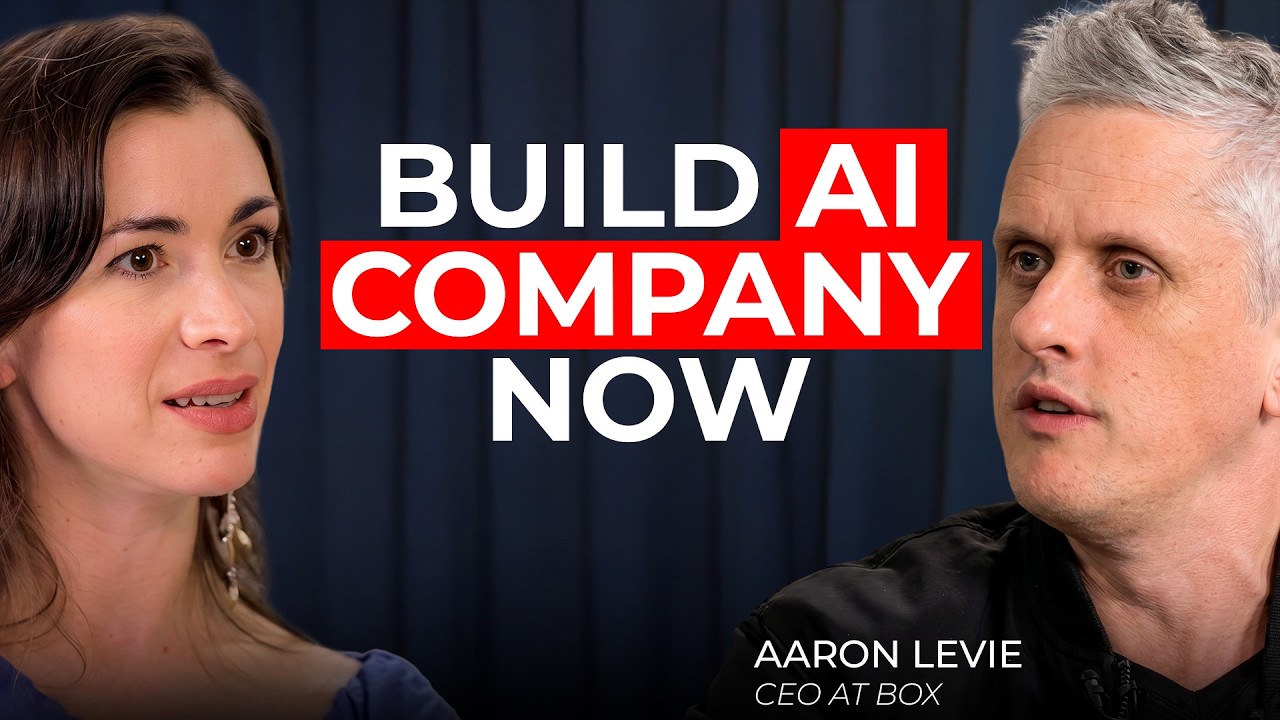
Aaron Levie is the founder and CEO of Box, a cloud content management platform valued at $4 billion that serves 64% of the Fortune 500. He regularly meets with enterprise CIOs to understand AI deployment patterns and has deep visibility into how large organizations are implementing AI across their operations. Levie built Box from his college dorm into a market leader in enterprise software.
Marina Mogilko: The more I play with AI agents, I do realize that I need a person at the beginning of the process and the end of the process. So I still end up having more people.
Aaron Levy: Some of it will be different roles, but I'm very optimistic that we're going to use this technology to grow more and do more as opposed to just replace. This is Aaron Levy, founder of Box.
Marina Mogilko: Welcome 4 billion company. 64% of the Fortune 500 uses his platform. He says we have 3 years to build the next generation of AI companies. These market windows happen every 10, 20, 30 years in technology. The mainframe, the personal computer, the internet, the cloud/mobile. If you were starting today, what would you do to find the right idea to test it and to make first money?
Aaron Levy: My first thing would be
Marina Mogilko: 5 days ago, you posted this. We're at a unique moment of history where anyone with high level of ambition and core skills in any area can overcome a lot of historical experience requirements for a role. Can you talk more about that?
Aaron Levy: So there's this interesting dynamic where a younger group—not necessarily in age but maybe in skill or time in that domain—can have as much leverage and in many cases even more because of their mindset differences than somebody that is super experienced in a field. Now, interestingly, the advice can go in all directions because you could have somebody maybe too early in that field and then use AI in the wrong way and get the wrong outcomes. Equally, you could have somebody extremely experienced that decides to adopt the technology and then they have a total superpower because they understand all of the contours of whatever they're working on, whether it's writing code or doing healthcare or doing biotech. And they will be even more capable of leveraging these tools if they have the kind of right mindset wiring to be able to leverage them. And so I think that the core idea is that we're just in this amazing moment where if you're super ambitious, you want to go deep in the technology. Ideally, you're technical or becoming technical, so you can really know your way around these tools. You can make up for lots and lots of years of skills that you would have otherwise had to go and develop. And I think that's an incredible thing for democratizing knowledge and skill sets and expertise.
I often am building things or designing things or coming up with things that in any other version of the world I would never have been able to do. But now I know just enough to be dangerous in those areas. And it helps me prototype. It helps me generate new ideas. It helps me work with colleagues faster because I can highlight the way I'm thinking about something where normally I wouldn't be able to draw on paper what I'm coming up with, but I just say, "Okay, this is the rendering that we're looking to do." And so again, I think that's an incredible technology that's available to everybody for those that want to adopt it and lean in right now.
Marina Mogilko: What would you say to someone who's watching this, but they've also heard a lot of news about layoffs, about college graduates not getting enough jobs because they're being replaced by AI? What would you say to those people?
Aaron Levy: Yeah, I think we're at a moment right now where these happen in history every couple decades or every 50 or 100 years where there's a major technology disruption or transformation and there's a lot of questions around: okay, where did that show up? Who are the people that get enabled by that and can do even more? Who are the people that maybe get displaced by that? And what do they do next? So we're in one of those periods where it's a serious topic and a real conversation. I do think that some of the negative commentary and messaging out of the industry or political institutions probably is overweighting the negative side and underweighting the positive side.
For instance, I'll give you one example. So there's a death of the software engineer topic that comes up because these AI models are really good at code generation. They're really good at writing code and when you look at them, you're thinking, "Oh my god, that's incredible how much code it just wrote and it wrote that code as well as another engineer would have," and that's totally true. But to get that code into production, to make sure that it's secure, to have it maintain an application on an ongoing basis that doesn't get hacked, to make sure it's integrated across all your other data systems and database and infrastructure, that still requires a tremendous amount of knowledge and expertise in the field broadly of coding and in software development. And so the people that are going to be able to best leverage the technology are actually going to be software engineers using code agents to be able to generate vastly more code output than they would have been able to before.
Marina Mogilko: But that's today. Do you ever think about like in 5 years AI is going to be able to do that? I don't know, look at the market, strategize around some problem that the market is not solving yet, build a company, develop software and that's it.
Aaron Levy: There's a lot of data signal that isn't digitized in a format that the agent can go with. And there's a lot of ways the agent can get confused by accessing the wrong information or doing the wrong thing that you didn't intend. And so for all of these reasons, it leaves humans in some kind of supervisory capacity for what these agents need to do. And so, does it need the same number of humans as we have today for the exact same workflow? No, not usually. But are there a lot of new workflows that businesses will now do because they have access to those agents? That's the bet that I have.
And so the way I think about it is this: if you think about that five-year-out scenario, let me paint a slightly different one. I'm a small business. Pre-AI, I was three people. We were selling something online. It was a good business. It paid the salaries of these three people. But let's pretend I had even more ambition and I wanted to go after a bigger market. What do I do if I'm those three people? Well, I have to hire a sales team and I have to hire a marketing team. And a lot of people are thinking, "That's a really high barrier to entry to grow my business meaningfully." Now, enter agents. I want an agent to generate this marketing campaign, or I want this agent to build a better website that delivers a better experience for my customers. Well, what happens next? If it works, now you have more customers. Now you have more supply chain issues. Now you have more customer interaction challenges. You have new features they want you to build. Then all of a sudden, because you had agents get you some of the way to getting some of the work automated, my hunch is that same three-person business becomes five people or becomes 10 people because they now have automation that's augmenting the prior constraints and limitations that they had. I think that's going to happen as much if not more than the scenarios where you have a company saying, "Okay, I have 2,000 engineers today. I'm going to have 1,500 in the future." I think it'll be a much more diffuse set of growth that happens through the economy. Some of it will be different roles, but I'm very optimistic that we're going to use this technology to grow more and do more as opposed to just replace.
Marina Mogilko: So Aaron and I have been talking about building an AI native business. One quick thing before we get to it. Look at your work right now. You maybe have one tab for emails, one tab for research, one tab for decks. They all run inside your company. The problem is none of them really know the others exist. Here's what that looks like for us. We record a podcast episode to turn it into a LinkedIn post. Somebody on my team opens the transcript, copies it to another tool from writing agent, then copies the output somewhere else. We do that for every single episode. The agents already exist. The bottleneck is that they can't pass work to each other. A person has to sit in the middle and move files around. That's what Out by Cisco is here to solve. They call it the internet of agents. An open infrastructure where your transcription agent can pass a file directly to your writing agent which can pass the output to your scheduling agent and there is no human in the middle. No manual copy paste. These agents are coming from different vendors or might be built on different frameworks. Doesn't matter. Verify who they're talking to and move the work forward on their own. It runs on existing protocols like A2A and MCP and it works with whatever you're already building. The open-source project is called agency.org. It's a Linux Foundation project, outshift by Cisco, was a co-founder with 80 plus members contributing to it today. If you're building with agents or just watching where this is going, go to outshift.com. Discover the internet of agents, an open interoperable internet for agent-to-agent collaboration. Now, let's get back to Aaron. And because we're doing more, we're basically consuming more, right? And solving more problems. So we're becoming a more abundant world.
Aaron Levy: More abundant. And you can't escape some ultimate constraint. There's always some constraint in the system. There's a new bottleneck that emerges. I have lots of things that I've tried to automate where at the end of the automation, the very next thing you have to do is a human has to do some work. It has to follow up with the customer because I just can't fully automate that entire process. It has to update data in some system. It has to go into three meetings and coordinate with some other set of people. It has to go to the customer's site and do some implementation. So there's always constraints in the system. We just haven't identified all of the new ones that happen when agents arise. There was a funny article about a week ago in the Financial Times where lawyers are now being inundated with questions from their clients because their clients are going to AI agents and asking questions about legal issues and they're drafting documents or whatever. But guess what? If you were to go draft a contract right now, the very next thing I predict you would do is you'd go and send it to a lawyer and say, "Can you just make sure this is going to hold up in court?" Because in the 3% chance it's not, which is basically maybe the hit rate of what an agent will get right or wrong, that's not worth the risk of saving $500 of talking to that lawyer.
Marina Mogilko: Same with financial advisors, right? You still want to run something through a
Aaron Levy: I am not that interested in automating my personal tax process. I am totally fine with the one-time fee to just make sure that is a clean process from somebody that has done this for 10 years or 20 years or 30 years and there are some parts of the economy which is naturally already where dollars tend to flow where I just want this done well. I want my doctor to be really good. I want my lawyer to be really good. I want my tax adviser to be really good. I want them using AI because if they could somehow review more of my data or look at more of my patient history or look at more of my legal history, that would only be a net positive. But I want that person ultimately to have some degree of accountability that's on the line. These agents have no accountability. They're not on the line. They're not on the line for anything. They're going to disappear in two seconds later.
Marina Mogilko: And you're not going to blame Claude or
Aaron Levy: I can't blame Claude. I can't blame Claude's weights. I can't sue Anthropic. All of those things we have rules we have laws we have accountability for the rest of the economy you don't in agents and so somebody eventually needs to take on that accountability and this is more of the legal related issues but there's still lots of things where you want to look at your contractor in the eye and say you can deliver this thing for me not in I'm going to sue you but just I want to make sure that you can deliver on that brand campaign and it's going to go
Marina Mogilko: Human brain human brain behind I even feel it with social media right I could totally generate a lot of posts with AI, but I just don't want to post AI generated posts. I want a person who knows my taste and my tone of voice to look at them. Yes, maybe generate ideas with AI.
Aaron Levy: There's another funny thing. This is totally random and not tractable in software over time. But there's another funny thing which is I do think people will get prompt fatigued at some point
Marina Mogilko: Which is like man I have to always prompt this agent the same way every single time just to make sure that it works or whatever like humans don't require that
Aaron Levy: But then you can do cloud project with instructions. Sure. And some people will get really optimized on that. But the nuance is there are some parts of your business
Marina Mogilko: Where you just want the person to be able to have that context. And you just want there are a lot of things I could probably automate if I put my mind to it really hard.
Aaron Levy: But now I am basically doing the work of five people and it's now I have to hold all of that context in my head as opposed to previously that context was in the head of those teammates. And at some point my brain's going to explode. I'd rather those people hold on to that context and it's worth it. The value of the thing being done well is worth it and worth paying for. And so I want that person to use agents but I don't want to have to keep track of all their contacts either because I run into a
Marina Mogilko: You're responsible for the process and it's in your brain.
Aaron Levy: I don't want to be responsible for our company's legal review process. I don't want to be responsible for the invoice process. I don't want to be responsible for the brand creation process. But that's maybe a really key point though that you just said which is the more agents you deploy for yourself the more you take on the role of the equivalent manager in another organization the human manager you basically have to be responsible for whatever the output is. And so the more horizontal you go in what you're giving agents the more functions you now have to
Marina Mogilko: The more your brain explodes.
Aaron Levy: Exactly.
Marina Mogilko: And you see this in the valley like people are totally tired. I have never met a founder or somebody working on a startup that's sleeping well and
Aaron Levy: My 50 agents are running my startup and I'm just sleeping.
Marina Mogilko: Nobody's doing that. It's the exact opposite. They are managing the 50 agents and they are stressed out of their minds.
Aaron Levy: I was talking to a lot of scientists and they're the ones who tend to be most worried. I talked to godfather of AI, somebody who's been studying AI for 15 years and they're the ones painting the picture or Yosha.
Marina Mogilko: Yosha, yeah.
Aaron Levy: Yosha. He's like, "We have two years." Like, what are they not getting?
Marina Mogilko: We've had two years for probably 10 years.
Aaron Levy: That's true.
Marina Mogilko: Listen, I have deep respect obviously like these are the best minds in AI and we are riding on their work. So obviously a tremendous amount of respect for what all of this category people have contributed and their ideas. I don't know if you've interviewed Yan Lecun, okay well it'll come and I kind of you know more in Yan's camp which is
Aaron Levy: There's still just a fundamental limit to these systems. They have to be the work has to be reviewed. Any error rate above 2% you still then need some accountability in the process and everybody says well humans are already doing that it's yes but back to the point I can fire the human and so there's some accountability at scale in the structure that exists where the agent just doesn't have any of that and so somebody has to take on accountability for the output of that agent in your workflow at some point because what you're not going to do is be fine when Bank of America says lost your money because the agent made the wrong investment decision and you're like okay but that's not why I hired you.
Marina Mogilko: Exactly.
Aaron Levy: And so that part exists very broadly throughout our organizations and throughout the economy. And so I think what some people in the AI ecosystem that lean more to the rapid takeoff scenario is that they're thinking that because the agent can do lots of stuff really well that that diffuses across the economy in a way that is destructive. And I don't know if it's a benefit, but it's certainly a reality. I have the pragmatic reality of working with enterprises day in and day out. And these are enterprises outside of Silicon Valley. They're in the real world. They're the manufacturers of our products. They're the banks that we bank with. They're the life sciences companies that develop drugs.
Marina Mogilko: And what these really amazing researchers and thinkers don't do is they don't talk to those people who are actually implementing these systems. And so they see this incredible capability take off, but they don't realize the diffusion of that AI across our organizations is ultimately constrained by and bound by 30 other things that doesn't relate to the super intelligence that's in that model. It relates to how do I implement this thing in a safe way with the right safeguard so it doesn't blow up my data structure. I just think that the time scales are wrong. The way that people imagine the AI being implemented in society is generally wrong. There's one real risk that I agree with, which is there is cyber security risks. There are risks of mis or disinformation challenges. Those are very real. We need to work through those. But I'm much less inclined to believe this thing takes off, it replaces all white collar work and then we're in some really bad scenario on that.
Aaron Levie: But we still hear all the news about layoffs happening due to AI. Do you think it's due to AI?
Marina Mogilko: Some of it is definitely not due to AI. It's overhiring during the zero interest rate era or the COVID era. So there's some phenomenon that relates to that. I would say that some of it definitely could be related to AI. There are some organizations that say, listen, I had 3,000 people working in engineering before. My product roadmap doesn't need to triple in scale. It needs to grow by 50%. And so I think that if each engineer can be 2x more productive and my roadmap only scales 50%, then there's some savings there as a result of that and they might do a layoff in that scenario. So I think that is real. It's not something that I can gloss over. But what I see from customers, and you can go online right now and I guarantee if you took five random companies in the Fortune 500, just as an example, take five random companies, I guarantee that every one of those five companies is hiring software engineers right now. And where are they hiring their software engineers? There's an interesting posting right now on Eli Lilly's career website for a lab software automation engineer. This is a role to use AI to help automate and increase review of lab results and automate the lab process in life sciences discovery. The general idea that AI is going to displace software jobs is not playing out empirically and I predict it will not play out ultimately.
Aaron Levie: Hearing that story, the thing I keep coming back to is that it wasn't talent, it was the system around her and it made me think about something very simple. Most people use Claude like a search engine. They type in a question, they get an answer, most times they're not really satisfied with it, and they close the tab. I did the same thing for months, and I was looking at people who were saying AI is changing their life, and I'm like, then I spent one afternoon setting it up properly, uploaded a few files about how I think and how I work, and it completely changed. I wrote the whole process up step by step. You get it when you subscribe to my newsletter, Future Proof. It's free. The link is in the description. So you think we're going to get more jobs in the next few years. When you're hiring now, how is it different from hiring 5 years ago? What are you looking for in a candidate?
Marina Mogilko: So I think right now is a great time to be going deeper technically. It doesn't mean you have to be coding all the time and building entire products, but you should try and really understand what is the agent doing, how does it work, how does MCP work, how do CLIs work, how do skills work, and getting really well versed in that. The people that are doing that will have a huge leg up in the next 3 to 5 years because all of these companies will be hiring for people that can do that within their workflows.
Aaron Levie: So we're definitely looking for people whose technical acumen is growing, whose AI savviness and fluency is growing. You want to be using these tools in your free time as much as possible so you understand how they're working and what's going on. At the same time I don't think a lot of this matters in the way that I think it actually still matters that you have some degree of domain expertise. Like you're really good at marketing, you understand what customers want, you're really good at selling, you're good at product management and interviewing customers and assessing markets. Those are timeless skills that transcend any kind of technology revolution. And so AI is just a way of augmenting those domain skills. So in some respects any role that we're hiring for—marketing, sales, finance, engineering, etc.—we need all of those domain skills, but also we need you to now be increasingly AI fluent or a little bit more technical.
Marina Mogilko: Can you recommend top three apps that people should be using?
Aaron Levie: You know, probably it won't be much of a surprise. I would download Codex. I would download Claude.
Marina Mogilko: Even for nontechnical people.
Aaron Levie: Codex 100%. Well, especially partly because Codex is becoming more inclined toward knowledge work use cases.
Marina Mogilko: And what should they be doing with it like automate a process within their automate a process give it just crazy problems and see what happens. Go do this research in this market. Wire up multiple MCP servers to data sources you have so you understand how does it work, how is it querying that other system, how does it access my email, oh scary.
Aaron Levie: No, actually I understand it now. Get a sense of how that all is working together. So I think just any one of the top AI tools for productivity, maybe for coding, is a good way to get started and it'll already get you 90% of the way there.
Marina Mogilko: So Codex, Claude, Perplexity—these are some easy ones to get started with and you'll have a good sense of what the market looks like.
Aaron Levie: Pride, Cloud, Co-work, Perplexity—like these are some just easy ones to get started with and you'll have a good sense of what the market looks like.
Marina Mogilko: Do you have any examples of workflows that you've automated for yourself and you'll never go back to manual?
Aaron Levie: The kind of things that I'll never do again is market research in a traditional way. So I'm often asking an agent to go and analyze a hundred different companies worth of trends or information. I'll just never do that again. I'll never go to Google and type each company in and do the research. I'm going to have an agent go and fan out, do all of that, and then maybe I'll click on the underlying sources and verify something or double check something. Lots of market analysis. I'll never open up a code editor and type code again. And I wasn't for the past many years anyway. But the reverse is true, which is now I can actually get prototypes built when I couldn't have before.
Marina Mogilko: So anything coding related, even design is like you just go to chat, you're like, "Hey, I need this idea done. Could you just make it look this?" And then it gets you the new image rendering model gets you 75% of the way there. You hand that off to a real designer and then they do the full thing. So there's a lot in the ideation, the creative process, the market analysis, customer research, all of those domains that I am heavily using AI for.
Aaron Levie: Is there a certain way you structured memory? Did you upload personal constitution like your principles of work? Is there anything like that that you've done?
Marina Mogilko: I'm less fancy on that front. Partly because I don't even know what I would write down because I'm all over the place. So I don't have a lot of things yet that I would know how to really document. It's more process specific. In which case, back to this reprompting issue, I'm more just on the fly giving it pretty clear instructions of exactly what to go do. So I feel like I'm a pretty good prompter.
Aaron Levie: So every time it's a long prompt?
Marina Mogilko: Every time it's a long prompt and I'll store those off in various places. By virtue of Box, we store lots of data. So I have lots of documents that have information in them that I'm using constantly, but it's not as awesome as a sole file or a personal constitution.
Aaron Levie: So it's not like we're talking right now and 50 agents are replying to emails?
Marina Mogilko: At the moment, no. If you get an email from me, that's a very huge mistake in our system. So I am not emailing you right now via an agent. Could that be a process that gets automated somewhere in five years from now? For sure. Just as we've always had automated email systems for sales reps or whatever.
Aaron Levie: But it probably won't be that it would be like, "Oh, hey, I have a question about this thing and then I'm going to have an agent go do that." Partly because that's actually the kind of context that informs me of what's going well, what's not working well. If I automated all of that, we wouldn't know the next thing in the business to go fix.
Marina Mogilko: So you don't have an agent that's running your business basically. Is there, because I talked to some entrepreneurs and they're like, I share all my business decisions with my AI and then it looks at all the conversations I've had with my team and it gives me strategies.
Marina Mogilko: I think that's really cool that use case. I think more startups are doing that. If we were at a brand new company and it was five employees, there's a very real chance I'd be doing more of those types of things because I would need to build out our first marketing engine and I need to build out our sales engine. I would be documenting way more of that. At our scale, the really interesting important work is being done across the organization. That type of work is more knowledge that our head of brand design or our head of product design or our best brand designer or our product managers in each of the individual domains need to know. The stuff that I do is look across those areas and try and add extra nudges in the right direction and course correct. An agent could certainly help give me advice for how to do that. But I'm still at the point in my life where I'm going to see if my brain can do it.
Aaron Levie: There's also the founder energy. When you're talking to your team, you don't want your agent to be talking to your team. I think there's going to be some spectacularly hilarious examples like that over time.
Marina Mogilko: We're already seeing them like company data being deleted.
Aaron Levie: Yeah. These agents are—I could be proven wrong about this and maybe in five years I'll be totally wrong. This is where Yan Lun I think would agree and some other people—you have this really interesting divide in the industry which is: are these probabilistic pattern recognition machines or are they truly able to go off on their own and think for themselves? Depending on where you land on that continuum, you have some big judgments that get made. I think about it as there's lots of business decisions I have to make or that lots of people have to make where it's a brand new net new event that happens and I couldn't have documented what to do in that situation. Maybe I could have if I spent a year writing down every single thing, but it's a new thing that happened. If I try and imagine an agent running around and everybody's asking the agent questions, it's only going to be able to answer the thing that previously I have in my repertoire of answers.
Marina Mogilko: Many of the things I'm working on are the brand new net new things in the organization. So me being an agent across the company would be useless because it would only help with the things we already know.
Aaron Levie: That makes sense.
Marina Mogilko: There's a lot of stuff. I'd say 80% of our corporate information is to be reused purposefully. You don't need people making up a new answer to an HR policy. You don't need people making up a new answer to what is Box's security functionality and how should I position it to a customer. In those cases, all of your enterprise information, which is what we do as a business, becomes valuable for agents because they can look at the documentation, they can look at the sales pitch, they can look at the meeting that was recorded, and that becomes very useful information for that kind of run rate—80% of your company's work.
Aaron Levie: But it's for specific work. So like founder strategy—you said some next great companies are going to be founded in the next three years and you gave a very specific timeline. Why three years?
Marina Mogilko: Well, it could be three and a half years.
Aaron Levie: It's not 10. It looks like we have a very limited gap in the market where you can build something great because then it's going to be another boring 10 years. The basic theory is these market windows happen every 10, 20, 30 years in technology: the mainframe, the personal computer, the internet, the cloud and mobile. There's already been four of these eras. If you look at the biggest companies in tech, they generally correspond with when these windows open. There are a couple that don't—Facebook sort of didn't correspond with any particular window. It was more of a social change that occurred as opposed to a technological change. But most other things—Google, Amazon, Microsoft, Apple, the real turbocharging of IBM in that era, Intel, and so on—they correspond to a new technology found at the foundation level emerging. Then you have this opening where a bunch of new companies respond to that. In our era, it was Salesforce and Workday and enterprise software companies like Box that were able to capture that moment. Then in mobile, it was Uber and Door Dash and another set of companies. We're in a window right now that has all the makings of that. AI is now emerging. Companies are going to want to apply this intelligence in various areas. There are going to be a lot of applied AI companies that bring that intelligence to businesses, to society, to consumers in these applied use cases. The only reason it's not 10 years is because there are a lot of network effects that get built. If you build one of these companies and you're capturing data from the customer and you're improving the feedback loop of the agent, that will just make your technology better and better over time, whereby at least on paper that product should become more strengthening its competitive advantage over time. That's why it's not like an infinitely long window because it's very hard to disrupt Walmart today because customers have been using it for decades. You kind of want to be in one of those spots as these markets are emerging.
Marina Mogilko: Are you seeing any gaps in the market where a startup should be working on right now?
Aaron Levie: Tons. I think there's still like everyone knows the example of Harvey right now for legal.
Marina Mogilko: I think there's still lots of job functions and industries that will have their Harvey. I don't think we've heard the end of "Harvey for X." There's going to be new infrastructure that gets built out because these agents are going to need new kinds of tools beneath them. There's all this new interesting stuff around when agents are doing work within software they need more headless technology that they have access to. They might need payments. Stripe and this new company Tempo are providing payments for agents. If an agent can pay money, then you can start to think through what the agent would pay money for, and there might be new businesses that emerge that the agent is now going to transact with. They're going to need data probably.
Aaron Levie: They're going to need infrastructure. They're going to need to do tasks for you in the economy. There are lots of things that you can start to imagine that will become new business models because of what happens with agents doing this work with a whole new layer of active creatures in the market, which are agents.
Marina Mogilko: If you were starting today, can you walk me through a plan—what would you do to find the right idea, test it, and make first money?
Aaron Levie: My first thing would be some mix of assuming that we've got the most intelligent system on the planet and we have this incredible AI intelligence. Just imagine that emerges. Then the question is where in the economy would that add the most amount of value? Try and think through like are there spots where an incumbent isn't effectively responding to that? That would be one framework. Another framework would be where in the economy is it hard to deploy agents because there are a lot of other systems that those agents need access to? That's usually where there's lots of work to be done to get the agent to work within the environment. I'm pretty excited by a lot of these new professional services, IT integration, consulting firms that are emerging because when you go to the real world and you're like, "Would you like to automate your work with Cowork or Codex or any of these systems?" They're like, "Yeah, that'd be awesome." Then they show you their environment and it's like, "Ooh, it's going to be a lot harder than you think."
Marina Mogilko: What markets?
Aaron Levie: Anything.
Marina Mogilko: Everybody.
Aaron Levie: Healthcare, law, life sciences, banking, every industry. Because if your company is more than 5 years old, pre-AI, your data is all over the place. You've got 30 different systems you're working with. Your workflows aren't documented to the prior point. So that's a lot of change management you need to do to implement agents. What does that spell? That spells opportunity for new services startups. That spells opportunity for the existing Accentures and Deloittes of the world. It's a little bit of an up-for-grabs market at the moment because of how much work there's going to be.
Marina Mogilko: How do you decide between building versus
Aaron Levie: Maybe the only thing is Mark Cuban has had this riff and I fully agree with it. There's going to be a lot of opportunity both for companies, but even just these will be roles that if you're graduating right now, you might want to think about: who's the person that shows up at the 10-person consulting firm in Minneapolis, just to pick a non-Valley location? Who's the person that shows up that helps them take advantage of AI? Because they don't have a big IT department. They don't have a way to wire up their agentic workflows very easily. That's going to be there's going to be tens of billions of dollars, hundreds of billions of dollars that get made between jobs and services firms in just that over the next decade.
Marina Mogilko: Also, as an entrepreneur, when I'm thinking about that, what if Claude just makes the process really easy? You just deploy an agent, they build a specific agent who goes into your email, whatever you have in your box, and creates the whole ecosystem for you. How do you think about that? Because these companies are getting more and more powerful. If I took your exact scenario and I'm like, an agent's going to read through my entire email inbox and then it's going to access Salesforce and then it's going to have some kind of workflow that participates in. Like even me—I've been building software for 25 years and I use every single tool that has ever been produced in AI. Obviously not literally, but pretty much I don't feel comfortable implementing that workflow right now.
Aaron Levie: So the idea that that 10-person company is going to go and set that up, and just because Claude became super powerful, I am skeptical that we ever get to that point. The reason why I'm not comfortable with that is I have to think through the guardrails of what happens if somebody emails me and then says, "Hey Aaron, I need you to pull up this Salesforce record for me that I told you I would look at and you can send me that information." Well, if my agent has access to my email and my Salesforce, then the agent should by design answer that email question and go pull in the Salesforce record and then send it out.
Marina Mogilko: That's like a non-starter. You can't just take any untrusted email coming in and then have the agent distribute information that your tool has access to. So even me trying to think through how to implement whatever your scenario was, I would have a hard time thinking through how do I set the right guardrails? How do I have the right alert mechanisms? How do I have the right human in the loop, like should I review all of the emails before they go out and have an interface to do that? Should I have some escalation mechanism that pings me on my cell if I need to look at something? How does the person on the other end of that email inbox get to me as the real person and escape the agentic loop that they're in? There's like 30 questions that I have thinking through whatever that workflow is. So it's not a matter of Claude is so powerful. It's a matter of how the systems talk to each other, the safety mechanisms of those systems. How do you define the actual workflow so it gets done in a safe and reliable way? That's the work that a technical person generally needs to go do.
Aaron Levie: Okay. So that's a big shift from being manual to getting automated as a company. What about niches where we see Figma stock go down when Claude releases the design feature? And if somebody's working on that type of feature and they're afraid that with the next Claude upgrade it's going to be gone.
Marina Mogilko: That's a different issue. That's a different category altogether, which is how much will Claude or these AI models eat into the business models of different industries or different providers. I think that's something where you just have to be very thoughtful right now to not just build anything. You have to build things where, even as AI agent progress continues no matter how much it continues, it could be infinitely powerful, there's still some other thing that agent is going to need to do. It's going to need to put its data somewhere, it's going to need to incorporate into a workflow, it's going to need a human to take the information and put it into the real world. Over time, more and more value will start to look like things where it's a well-governed process that has lots of security or compliance needs. You have to trust the underlying system. Probably personal productivity tools maybe will be less relevant. At the same time, like in the Figma example, I think Claude design is very cool, very powerful. I play with it a bunch and it generates amazing designs. But at the same time, I still want our design team doing the last mile of work. Right now, they're doing that last mile still in Figma. Even these things are not as binary as I think maybe Wall Street would suggest. So that's why it's still a pretty dynamic period right now.
Marina Mogilko: Yeah. And it's also because I feel like the stock reflects what we're thinking about the next two years, and because this is evolving so fast, sometimes as an entrepreneur I'm asking myself, okay, I'm building these apps, why don't a language learner just go into ChatGPT and build the Apple VIP code and apply themselves? I think it's a question that every entrepreneur should have a very big whiteboard that thinks through various game theory events that could happen and where will your value get compressed and where will it not. It's hard to have a perfect answer in any kind of generic way because it is a very busy, complicated time. But again, ironically, in a macro sense I think the more that AI is doing in these automated things, you're just going to see new constraints begin to emerge. A lot of people have healthcare as a classic example, and I think Jeff Hinton had a riff, and I don't have the perfect quote, but I think he felt like radiology would reduce as an example because AI will get really good at looking through radiology images.
Aaron Levie: And self-driving.
Marina Mogilko: And now we still have radiologists driving to work every day.
Aaron Levie: Oh sure, I think it was that.
Marina Mogilko: Yeah. So what also happens is these other things that occur. We might have AI that gets the radiologist 90% of the way there to look at the right thing or get some suggestions. At the exact same time, what that's meaning is we're doing vastly more imaging. We're doing vastly more scanning. Way more people now can go do it.
Aaron Levie: More accessible.
Marina Mogilko: And it's more accessible. So actually now the demands on that role end up increasing as a result of that. There's a lot of parts of the market where AI facilitates lowering the barrier to doing that work, and by lowering the barrier to doing that work, more people participate in it, and as more people participate in it, a new constraint gets backed up that now real people need to go and work on.
Aaron Levie: I feel like the more I play with AI agents, I do realize that I need a person at the beginning of the process and the end of the process, so I still end up having more people.
Marina Mogilko: Yeah. And it's just a question of how many roles do you want to play within your company or your team? Do you want to play designer, developer, marketer, strategist, sales rep? No, you're just like, I just want to sleep at some point. So the solo entrepreneur is already used to that because they've been doing that forever. When I did startups before Box and I was a solo founder, I had to do 10 things and I was so tired, and if I could have ever hired somebody to do half of those things I would have. So could AI allow us to get these companies to a little bit more scale to the point where then you can hire that next person? That's more of where I think this would go.
Marina Mogilko: And do you think it's the best time to start a company now?
Aaron Levie: I'm a stickler for this one key point, which is it's only the best time to start a company if you've got a great idea. I think that great ideas can exist in any kind of period of time. But I'm not in the camp of just everybody should start companies, because it's really hard work. It's extremely stressful. You're working mad.
Marina Mogilko: I don't think that people should feel pressured into starting something because it's one of these windows. When I say it's one of these windows, it's just to reinforce the point that this is the moment where the best ideas probably will get built. That doesn't mean that you should start one. It just means you don't have to rush yourself to starting now.
Marina Mogilko: Because if you rush yourself to starting a bad idea with one of these moments, you're no better off. So, I would say it's a good moment. You have an incredible amount of leverage. That also comes with more competition.
Aaron Levie: Because basically by lowering the barrier of getting ideas out in the market, what do you get? You get more competing ideas. If you get more competing ideas, that's more noise that customers have to deal with. So interestingly, and back to the jobs thing again, it's not so much the idea getting the idea out there that's going to matter. It's going to be: do you have somebody talking to customers? Do you have are you doing sales? Are you doing marketing? And so there's a new constraint which is the constraint isn't code generation. The constraint is are you in front of customers enough and are you marketing enough?
Marina Mogilko: Which is a new set of dollars.
Aaron Levie: If you could become 19 again today and start over would you exchange that to what you've currently built? Would you do that?
Marina Mogilko: Am I starting in 2026 or back in 2005?
Aaron Levie: 2026 as a 19-year-old. Would you do that or would you just stay put with what you've done?
Marina Mogilko: Oh I see. Well, I'm the most excited we've ever been on what we're doing now. I would certainly pursue what we're currently doing because part of it is historical, which is we've earned the trust of 120,000 customers, which is a good launch pad for the next set of things we wanted to go do. I just love the things that we get to do with customers. We get to work with every industry and every size company and we get to help space launches and medical discoveries and blockbuster films get produced. So I'm very excited by what our platform does with agents.
Marina Mogilko: At the same time, I have lots of friends that are doing companies and I'm like, "Oh, that's a really cool idea right now." And it looks very exciting and so I'm just in a period of being impressed and excited by lots of stuff. While also being incredibly stressed constantly.
Aaron Levie: Any jobs that are going to disappear in the next 5 years? I think there's going to be work that gets compressed and then I think you're going to take those people and often repurpose them for more of the agent manager escalation path or proactive versions of that work. A very clearly obvious one is something that companies have always tried to automate to some degree. If you're emailing a company saying I need you to reset my password, that is probably not going to be a person.
Marina Mogilko: Like customer support, right? Customer support. But even that.
Aaron Levie: Customer support is this funny one which is we think about it as a monolithic thing because we call it customer support. There's tiers of customer support. There's the first line of customer support that we will most certainly automate, which is change password, reset password. There's a lot of tasks like that where I need to download this thing, I can't log in, I have this issue, whatever, that we're going to fully automate.
Marina Mogilko: But there's a lot of customer support which is I need you to get on this call with me and look at my specific problem on my computer and why this thing isn't working and we just have no way to automate that.
Aaron Levie: Maybe we'll automate the next line of questions, but you can't get to the final thing. I had a friend have a problem with Box two weeks ago. He just sent me some screenshots and there's a zero percent chance that he would be able to have asked the question with an agent.
Marina Mogilko: So it had to be you.
Aaron Levie: Well, in this case, it actually had to be a senior product manager. I had to get the senior product manager to the person, but he couldn't have talked to a chatbot and answered the question.
Marina Mogilko: But what about like bookkeeper?
Aaron Levie: I had an issue with my Mac last week. I spent 10, 20, 30 minutes on AI trying to diagnose it. Never worked. Had to call them. They had to come and diagnose it. Couldn't replace that.
Marina Mogilko: What about jobs like bookkeepers?
Aaron Levie: Some of these jobs have already been on the path to automate as much of that away as possible and so agents are just another layer in that. But again, the same answer. There's still always an escalation path because there's always the exception. There's always the weird anomaly that occurred.
Marina Mogilko: And you can't have the thing that you can't do is I can't moonlight as a bookkeeper. I can't moonlight as a lawyer. So at some point there still is this final path in the escalation which is I may have been able to automate 90% but you still have that one part. I had this legal question two months ago and I asked every AI agent the same legal question and every single one basically gave me the same answer and then I called a lawyer and they basically gave me a much more contextualized answer because they could decide how much risk I wanted to take on or not take on.
Aaron Levie: Knowing your personal situation, right? They know my personal situation. And they also know the fact pattern of how does the industry tend to think about this one thing and all the AI agents were giving the mean answer of that particular topic which is in this case the more conservative answer. It's the thing that it should be trained against because it's not going to give you the more liberal risky answer.
Marina Mogilko: But when you talk to a lawyer they're like well actually yeah this situation won't actually occur because of XYZ fact patterns. And so those are the kind of things where you then are like I want somebody that has seen 20 years of this stuff. I don't want a model that was just looking at Reddit and deciding how to use that information.
Aaron Levie: My two last questions. You have a six-year-old, right?
Marina Mogilko: Almost seven, but yes. And four and seven and a half months.
Aaron Levie: Oh, congratulations. Are they going to go to college?
Marina Mogilko: Shoot. Maybe I shouldn't have leaned in so much to the question. I am here. Here's the one problem with me as a B2B enterprise software person. I am boringly pragmatic, and so I just think change happens more slowly. It's funny because I have this weird duality. I adopt every tool. I was wearing Google Glass in week two. I buy every VR headset. I lean into every one of these tools because I'm excited. As a personal user, I love technology breakthroughs. It's amazing. And then I go in the real world, and I'm just like, man, that whole system over 300, 500 years that we've built up—is that really going to change because of this one variable? So on the college thing, I struggle because on one hand, from first principles, it doesn't have to exist. My almost seven-year-old is already way smarter than I was because every question that comes to his mind, we're looking up the answer right away. I don't have a perfect memory of being seven, but I didn't have an instant resource for every question. He wants to know how fast a peregrine falcon can fly, we get the answer. He wants to know how big the Atlantic Ocean is, we get the answer. He's just a sponge for unlimited information. On one hand, you're thinking wow, that could probably replace a lot of the traditional ways that we think about these institutions. But on the other hand, what is college other than another four years of high school but with a little bit more vocational orientation? A network of people that you want to be with and learn with and make connections with. A transition period into the real world because you're still young at eighteen. So then I'm like a pragmatist. Does that really change in this super intelligence world, or is the curriculum just changing and the format maybe changes? Does everybody want to just be at home with their parents talking to an AI bot? No. So I have these other counter pressures. Things that should and must change at a societal level: man, can we have college cost a fifth of what it does? It's insane. Should you really go into debt for twenty years because you went to medical school or got X degree? That's incredibly insane. So should we use abundance to bring the cost down and do that as much as possible? Absolutely. There's some things that need to change about college, but does the very concept change? I always struggle with that one.
Aaron Levie: Same here. I feel like as society we're really slow to just change dramatically when it comes to foundations. College is one of them. Okay. Last question—advice for entrepreneurs who are starting today.
Marina Mogilko: I would say lean into the tools. Learn the technology, see what's possible with it. Make sure you're riding the tailwind of what's happening in technology. You don't want to be hitting a headwind where you're going against the grain of AI. You want to be riding the AI wave. That can mean a number of things. It might mean do things that actually in a world of AI become more important because people don't want AI to do that thing. It's counterintuitive—riding the AI wave might mean do a live events business.
Aaron Levie: That's what a lot of people are doing.
Marina Mogilko: Yeah. Do something where we will appreciate this other thing in the economy because AI is so abundant. AI makes getting healthcare questions answered so quickly, so you should probably be doing hospitals because now more people are actually going to be needing wellness clinics. There's just sometimes a technology thing that you do, sometimes a thing that the technology is related to an underlying broader societal trend that will become more important. These consulting businesses that help deploy AI. I just think there's going to be a need. Build a childcare service because we're all exploding and we need help with kids. There's all this stuff that is going to need to exist.
Aaron Levie: Thank you so much. I like your positivity, especially after talking to some scientists on this podcast.
Marina Mogilko: Thank you. Thanks a lot.